![Revolution Arena [English Version]](https://revolutionarena.com/english/wp-content/uploads/sites/4/2024/07/Revolution-Arena-ISSN-2966-2117.png)
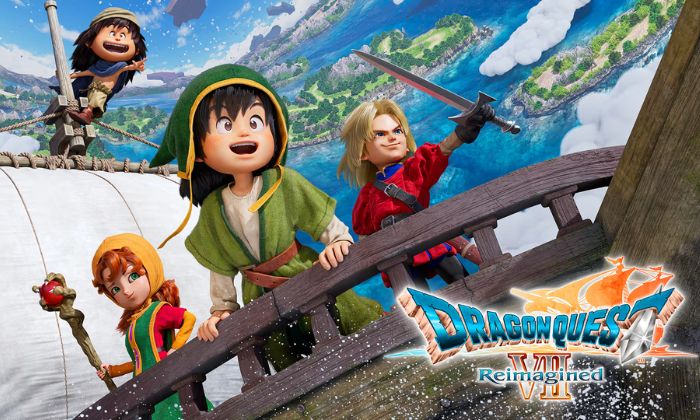
Dragon Quest VII Reimagined – Review
February 8, 2026I swear I tried to start this review in a “normal” way, but it’s impossible. Dragon Quest VII: Reimagined is the kind of game that grabs you by the hand with a “come here, sit down, let me tell you a story” look, and before you know it, hours have passed. And the craziest thing is that it does this without trying to be modern, without trying to become something else, without losing the soul of a classic JRPG. But at the same time, it also doesn’t want you to suffer with the old limitations that, back then, were accepted “just because.”
I played it on the Switch 2, switching quite a bit between handheld and docked mode, and the feeling I had the whole time was: “Okay, this isn’t just a visual overhaul. This is an old game being reworked with care and a real obsession with making everything more enjoyable to play in 2026.” And yes, I know that “reworked” can be scary, because that doubt always creeps in: did they change too much? Did they cut out things they shouldn’t have? Did they simplify it to the point of being boring? Reimagined walks a tightrope, and I felt that at various points. But, overall, it almost always lands on its feet.
For those who have never played DQVII, its structure is different from many JRPGs. Instead of being a straight road with a giant villain on the horizon from the very first hour, here the game is almost a collection of stories. One “island at a time,” one “problem at a time,” and this format makes you become attached to the world in a very particular way. And then, when the larger plot begins to come together, it clicks: “Wow, all of this was pointing here.”
The premise is simple and works very well. You’re a boy living on a quiet, somewhat isolated island. But there’s a huge mystery in the air: why does it seem like that’s the only island that exists? Where is everyone else? Along with Prince Kiefer, who has a “let’s meddle where we weren’t invited” kind of energy, and Maribel, whose presence steals the show in the most bossy and fun way possible, you end up finding a sanctuary and… that’s it. From there, the adventure becomes a hunt for fragments of tablets that open paths to the past. And the great thing is that, by solving the drama of an island in the past, it comes back to life in the present. You literally see the world being rebuilt by your actions.
Mechanics and Gameplay
Dragon Quest VII: Reimagined is, at its core, the kind of JRPG you can understand in five minutes: exploration, towns, NPCs, dungeons, items, bosses, and turn-based combat. But the difference lies in how much it tries to remove friction that, in older versions, made the experience more tedious than necessary.
The structure, “one island, one story,” and the rhythm of the game.
The game works like a sequence of mini-arcs. You arrive on an island in the past and encounter a specific problem. Sometimes it’s funny, sometimes bizarre, sometimes surprisingly heavy. It could be a city with a strange curse, a village where something terrible happened, a situation that seems like a joke but turns into a drama, or a conflict with a very human touch. You solve it, and when you return to the present, that island “appears” on the map. Then you can revisit it and see how everything turned out after what you did.
This is brilliant for two reasons. First: there’s always a sense of novelty, because each island changes the theme. Second: the game creates a delightful butterfly effect that’s great to follow. You help someone in the past and, in the present, you encounter the consequences, good or bad. And yes, you can’t always “save everyone” perfectly. Sometimes you don’t reverse a tragedy, you just prevent it from getting worse, or help people move on. This adds an unexpected weight to a game that, visually, is super cute.
Regarding pacing: Reimagined tries very hard to make the game move faster. It reduces unnecessary delays, shortens tasks that were previously repetitive, and, most importantly, gives you tools to avoid getting stuck. I felt that the game has less pointless back and forth and fewer moments where you think “I’m just doing this to pad out the time.” It’s still a long, gigantic RPG, the kind that can easily take dozens and dozens of hours. But now it respects your time more.
At the same time, I’m not going to lie: it’s still a “dense” game at the beginning. Even with adjustments, there’s still that feeling that the first few hours are preparing you, introducing you to the world, asking for patience. For me, it was worth it. But it’s understandable for those who feel it takes a while to “give you new toys” in the progression system.
Exploration with enemies on the map and fewer interruptions.
One of the best features is the exploration with visible enemies on the map. No more being randomly attacked every two steps. You see the monsters circling, you choose to fight or dodge, and this completely changes the exploration experience. Want to just traverse an area because you’re focused on the story? You can. Want to farm because you hit a boss that crushed you? You can do that too.
And there’s a delightful detail: much weaker enemies can simply be defeated with a single hit on the map, without engaging in battle. You receive rewards and keep walking. This seems small, but in a huge RPG, it’s a real treat.
The game is also very generous in terms of navigation features. It has markers, clues, characters that point out directions, and the map itself is very helpful when you’re hunting for important fragments. I almost never got lost for very long. And when I wanted to explore on my own, I could, but it’s clear that Reimagined is afraid of leaving you stuck.
Turn-based combat, auto-battle, and speed.
The combat is classic Dragon Quest: choosing commands, managing MP, healing, buffing, debuffing, dealing with status conditions, exploiting weaknesses in a more “intuitive” than technical way. It doesn’t try to compete with the ultra-complex systems of some modern JRPGs, but it works very well because it’s clean, straightforward, and has that charming “comfort” feel.
But Reimagined puts combat on a much more enjoyable track with three pillars:
1) Adjustable battle speed:
Speeding up animations and commands transforms the game. Fights that would be “okay” become “fast and enjoyable.” And that’s invaluable when you’re in a dungeon, in the middle of a long sequence, or just want to advance.
2) Very competent tactics and auto-battle.
You can configure fighting styles and let the team act on its own. And it’s not that dumb auto-battle that only does basic attacks. You can guide behavior, prioritize support, save MP, use everything without hesitation. I used it a lot for weak mobs. For bosses, I liked playing manually, because that’s where the fun of thinking turn by turn comes in.
3) Special “turbo mode” comeback moves:
In more intense fights, characters can enter a special state that charges with damage dealt and received. Then you decide when to activate a strong effect linked to their vocation. This adds a twist that doesn’t break the game on its own, but becomes that push that can turn a fight around. I liked it because it creates “now it’s going to happen” moments.
Monster Hearts and special enemies
Besides the common monsters, I encountered special, more dangerous enemies on the map, and defeating them yields really cool rewards, including Monster Hearts , accessories that provide extra effects. This really appealed to me because it activates a “collect and test” instinct. One heart can regenerate HP per turn, another can save you from a KO, another gives a situational bonus. It’s a simple system, but it increases customization without becoming a spreadsheet.
Vocations and Moonlighting: the system that traps you
Dragon Quest VII features vocations, a class system where classes evolve separately from the character’s level. You master a vocation, gain skills, unlock more advanced vocations, and so on. In Reimagined, this became more interesting for two reasons:
- There are more options and settings in the system.
- And the highlight: Moonlighting , which allows you to equip two vocations at the same time.
This changes a lot. I could keep a “main” vocation and experiment with a secondary one to mix skills, bonuses, and styles. Suddenly, a character that I would have kept locked into a fixed role became a walking build laboratory. And in such a long game, this is essential to avoid falling into monotony.
Now, a real criticism: the game takes a while to unlock the full vocation system (or at least for it to become the center of your loop). Until then, you’re stuck on a more traditional path of “leveling up and changing equipment.” If you’re the type who needs constant mechanical progression in the first 10 hours, this might be annoying.
Difficulty adjustments and experience customization
Here’s where one of the most “2026” decisions in the game comes in: you have options to adjust the experience. You can make it more challenging, you can make it easier, you can reduce the grind. I like it when a game does this without judging you. Want to play for the story? Go ahead. Want to suffer and optimize? Go ahead too.
The side effect is that, by default, I felt the game was less tense than I expected at several points. Between abundant resources, frequent healing points, and a lighter penalty for losing, the adventure becomes more “breezy.” For me, this suited the atmosphere, but I understand those who would prefer more pressure.
Graphics
If there’s one reason why Dragon Quest VII: Reimagined looks like a “new game” at first glance, it’s the visuals. The art direction follows a diorama style , with a meticulously crafted model look, and characters that resemble figurines, dolls, and detailed miniatures come to life. It’s a style that might seem strange at first, because it deviates from the “standard 3D anime,” but once it clicks, it clicks perfectly.
Dioramas, depth and handcrafted feel
The cities seem meticulously crafted, with interiors that don’t give the impression of being “copy and paste.” The settings have texture, volume, that “I’m looking at a finished scene” vibe, but at the same time everything is alive, with animations and small details giving it personality.
I really enjoyed how this connects with the DNA of Dragon Quest. Toriyama’s monsters become incredibly expressive in this style. Slimes, strange creatures, enemies that are both funny and menacing at the same time, everything feels more “tangible.” And the facial expressions and animations of the characters convey the humor and emotional moments well.
Palette and visual interpretation
Not everything is super colorful like some of the more vibrant games in the series. In certain areas, I felt a softer, even somewhat muted tone, depending on the scenery and lighting. It’s not ugly, far from it, but it creates a different identity than what many people imagine when they think of Dragon Quest.
Another detail: in the Switch 2’s portable mode, in some situations I noticed a slight loss of sharpness compared to the docked mode. It’s not a problem that ruins the experience, but it’s there.
Edge effects and detail loading
It has a visual blurring effect on the edges (to give a sense of depth and focus on the center) that, most of the time, I forgot existed. But in some areas it catches your attention and, occasionally, you can notice textures “coming in” with more detail as you move. It’s the kind of thing that appears when you’re very attentive or when you fall into a specific area that highlights it. For me, it was just a small “scratch” on a visually excellent work.
Sound
Dragon Quest without good music is like a cake without filling. It works, but nobody wants it. And here, the game delivers.
Orchestral soundtrack and atmosphere
The music has been reworked with an orchestral treatment that perfectly matches the adventurous atmosphere. It has that playful spirit, that feeling of travel, and at the same time there’s room for more serious and even sad moments. On islands with heavier stories, the soundtrack helps to provide the right weight without becoming overly melodramatic.
Now, honestly: since it’s Dragon Quest, you’ll hear very memorable themes a lot. Some might find it repetitive over time, especially the battle music. I, personally, go into “this is part of the ritual” mode, but yes, it depends on your tolerance level.
Effects and feedback
The sound effects are well-polished: blows have impact, spells have identity, menus have that satisfying “click,” and the monsters have sounds that match their personalities. This greatly helps the game feel modern without having to reinvent everything.
Dubbing
The voice acting (when it appears) is of good quality and brings the characters to life. It doesn’t cover absolutely everything, so you’ll still be reading quite a bit, but when it kicks in, it improves the delivery of the scenes. I played knowing that the focus is more on text, and for this type of JRPG that’s normal.
Fun
I’ll be blunt: I had a blast. And it wasn’t the kind of “constant explosion” fun. It was the kind of fun that comes from comfort, from a pleasant routine, from “just another island,” and before I knew it, dawn was breaking.
The loop addiction
The game’s loop is addictive because it always gives you a clear objective, but with room to breathe. You explore, find fragments, solve a story, return to the present, see the result, resupply, and move on. And since each island has a different tone, you always want to find out “what’s next”.
Stories that stick
Not every mini-story will resonate equally with everyone. Some are sillier, lighter, more “okay.” But when the game hits the mark, it hits it big. There are stories that start out funny and end with an unexpected weight. There are moments of friendship, courage, farewell, guilt, and new beginnings. And the best part is that it doesn’t need a pyrotechnic show to be memorable. It simply places human situations in fantastical contexts.
Personalization without the stress.
Moonlighting, vocations, Monster Hearts, auto-battle tactics, difficulty adjustments, battle speed. All of this together creates a game that you mold to your mood. Some days I want to play seriously and optimize. Other days I just want to advance the story and enjoy it. The game allows it.
The only drawback is precisely this: depending on how you configure it or how the default settings are adjusted, the adventure might become “too good” for you, in the sense of being too easy, too comfortable, lacking that good, classic dungeon-crazed anxiety. I felt a bit more tension was missing in some sections, and that’s a very clear design choice here.
Performance and Optimization
On the Switch 2, the game was a very solid experience for me.
Frame rate and fluidity
Overall, the performance is smooth. The exploration and combat feel very fluid, and that’s very important in a large JRPG because you spend a lot of time walking around, battling, and navigating menus. I played quite a bit on the handheld and also docked, and the stability gave me confidence.
Resolution and loading
Overall, the image is very sharp. On the portable console, as I mentioned, there’s sometimes a slight smoothing, but nothing that took me out of the game. Loading times were quite reasonable. I didn’t experience that annoying “door opened, pause, door closed, pause” that some large RPGs end up having on portable hardware.
Minor technical details
The only things that caught my attention were those sporadic moments of texture detail loading due to edge focus/blur and the “fog”/effect on the sides in certain areas, which might bother those sensitive to it. But overall, it’s a very well-done port and a beautiful showcase for the Switch 2 for a game of this size.
Conclusion
Dragon Quest VII: Reimagined on the Switch 2 is one of those remakes that doesn’t try to “fix” the old game as if it were a mistake. It attempts to translate the experience to the present, maintaining what makes DQVII DQVII, but cutting friction, speeding up what needed speeding up, and giving the player the tools to experience the adventure at their own pace.
The result, for me, is the most enjoyable way to engage with this story today. The episodic format of islands and mini-stories is addictive, the effect of seeing the world unfold in the present after your actions remains one of the most satisfying narrative tricks I’ve ever seen in a JRPG, and the diorama art direction gives it a very strong visual identity. Add to that an orchestrated soundtrack that fits perfectly and a quality-of-life package that reduces friction without ripping the heart out of the game.
But it’s not perfect, and it won’t please everyone in the same way. If you’re a purist, one of those who love the “rawer,” longer, rougher version, with more intact content and a greater chance of getting lost, there’s a real chance you’ll feel that Reimagined has “smoothed things out” too much. There are content cuts, simplifications in certain aspects of the progression, a constant nudge to prevent you from getting stuck, and the standard difficulty is more lenient, with more resources and less punishment. This changes the feeling of the journey. It becomes less oppressive and more comfortable.
But for a current audience, especially a young one, especially those who want a classic JRPG without having to contend with the customs of two decades ago, this version is much easier to recommend. It’s long, yes. It’s traditional, yes. But it’s welcoming, beautiful, fast-paced in just the right way, and full of stories that, when they hit the mark, hit the heart.
Recommended? Yes, very much so. Especially on the Switch 2, which delivers a fluid experience with a high-level presentation. Just go in knowing that this is a DQVII with a more user-friendly approach and less of a “thorn in your side”. And, honestly, I wouldn’t complain about that.
Positive points
- The diorama-style art direction is beautiful and full of personality.
- Much better exploration with visible enemies and no random encounters.
- Defeating weak enemies on the map saves time and improves the pace.
- Moonlighting (dual vocations) makes builds and progression much more fun.
- Monster Hearts adds extra customization in a simple and addictive way.
- Speed options, auto-battle, and adjustments make the game much more accessible.
- Episodic stories have very high peaks, with truly memorable moments.
- Performance on the Switch 2 is quite stable and fluid most of the time.
Negative points
- Cuts to regions and chains of sidequests can frustrate veterans.
- Standard difficulty is lower, with less tension and more “comfort”.
- It takes a while to fully unlock the vocation system.
- Some mini-stories vary in impact; not all will resonate with you in the same way.
- Blurring the edges and subtle texture transitions can draw attention.
- On a laptop, the image sometimes appears a bit smoother than when docked.
Rating:
Graphics: 9.5
Fun: 9.0
Gameplay: 9.0
Sound: 9.0
Performance and Optimization: 9.0
FINAL SCORE: 9.1 / 10.0