![Revolution Arena [English Version]](https://revolutionarena.com/english/wp-content/uploads/sites/4/2024/07/Revolution-Arena-ISSN-2966-2117.png)
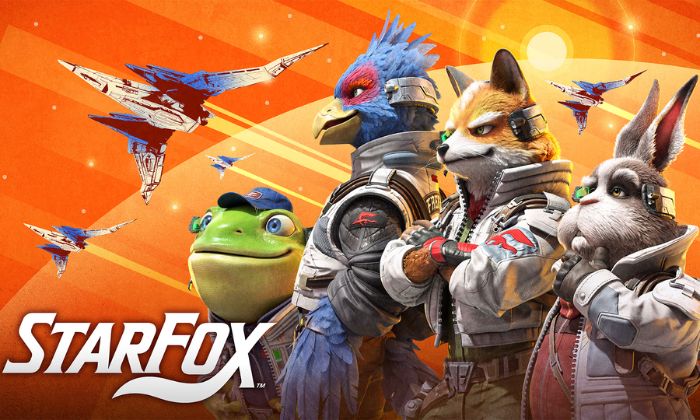
Star Fox – Review: The legend of the Arwing returns more beautiful and exciting than ever!
June 24, 2026There are Nintendo franchises that hold a special place in the hearts of those who grew up playing in the 90s and early 2000s, and Star Fox is definitely one of them. I remember the first time I picked up a controller and saw Fox McCloud’s smiling face appear on the screen, ready to fly through the far reaches of the Lylat system on frantic, adrenaline-filled missions. It’s the kind of experience that sticks in your memory in a way that few games can, and that’s exactly why the announcement of a remake for the Nintendo Switch 2 left me with a huge mix of expectation and apprehension.
Ultimately, it’s no secret that the story of Star Fox is, curiously, also the story of a game that Nintendo simply can’t stop remaking. The original Super Nintendo title was already an impressive technological leap for its time, but it was the Nintendo 64 version, released in 1997, that truly stuck in the collective imagination of fans. Then came the remake for the Nintendo 3DS, then Star Fox Zero on the Wii U in 2016, which disappointed many, and now, almost ten years after that nebulous episode, comes this new Star Fox for the Switch 2, developed by Velan Studios and published by Nintendo. It’s practically the fourth or fifth time we’ve played the same story, depending on how you count it, but I needed to know: was it worth it this time?
After spending many hours flying through the Lylat system, exploring every alternate route, facing the bosses once again, and diving headfirst into the new game modes, I can safely say that the answer is yes, with some important caveats. This is undoubtedly the most beautiful, best-presented, and most complete Star Fox I’ve ever played, but it carries with it some limitations from the original 90s game that this version didn’t dare to fully resolve. Even so, I came away from the experience more excited about the future of the franchise than I have been in a long time. Now let’s stop stalling and get down to business.
Mechanics and Gameplay
For those who have never played any previous version of Star Fox, the premise may seem simple at first glance: you pilot an Arwing on rail shooting missions, going from planet to planet through the Lylat system until you reach the final confrontation against the villain Andross. And at its core, yes, it is simple, but in a way that works very well because it was built on a solid foundation that time has proven to be almost perfect for the arcade style the game proposes.
During most missions, the Arwing automatically moves through the environment while you control its lateral, vertical, and diagonal movements, dodging enemy fire, asteroids, structures in its path, and any other threats that appear. The control scheme has been modernized in this version and is excellent: the movements respond precisely and pleasantly, and the learning curve is smooth enough not to alienate newcomers right away, but offers enough depth to keep veterans engaged for a long time.
The Barrel Roll, that spinning dodge that became an eternal meme in gamer culture, is still here and remains essential for surviving in the most complicated situations. You also have the use of thrusters to accelerate or brake, which opens up space for some really cool tactical maneuvers, especially in the open field sections, where control is completely free and you can fly in any direction without the camera being stuck on rails. In these open field phases, the need to position yourself well, chase enemies and at the same time avoid taking damage increases considerably, and I found myself completely immersed in these moments.
The feeling of piloting the Arwing in this version is simply the best I’ve ever experienced in any game in the series. The ship responds fluidly and naturally, as if I were truly in control of something powerful and agile, and the moments of juggling enemy lasers while aiming at the right target are genuinely thrilling. Besides the Arwing, in some specific levels I piloted the Landmaster, which is a kind of heavy flying tank, and the Blue Marine, a submarine. These alternative vehicles serve as a welcome variation in the pace, even if they are limited to only a few missions throughout the campaign.
Another noteworthy aspect of the gameplay is the alternative route system, one of the most intelligent and rewarding elements of the game’s structure. Each mission contains hidden secondary objectives that, if completed, open paths to planets and stages different from those you would find on the standard route. This means that no playthrough is exactly the same as the previous one, and exploring all possible paths to the true ending of the story requires multiple playthroughs. Each route has its own secrets, its own bosses, and its own twists, making replayability a genuine point of attraction and not just an artificial device to extend the game’s duration.
In this version, Nintendo and Velan Studios have made this system a bit more accessible than it was in the original: after completing a level for the first time, you can see on the map what the requirements are to unlock the alternative routes for that stage. For those who have never played before and don’t have decades of accumulated muscle memory, this is a huge help, and I honestly think it was a wise decision. For seasoned veterans who already have everything memorized, the option to ignore this information is right there.
Challenge Mode, one of the major new additions in this version, deserves its own paragraph. After completing any level in the campaign, it becomes available in Challenge Mode with a series of specific objectives to be completed in that stage. These include things like completing the stage within a time limit, defeating a specific number of enemies of a certain type, or fulfilling a special request from a character. I spent hours in this mode, and it’s easily the part of the game that held my attention the longest. The objectives on Normal difficulty are already quite varied, and those on Expert difficulty are brutally demanding, testing not only my knowledge of each stage but also my ability to execute maneuvers with surgical precision.
The local cooperative mode, where one player controls the Arwing’s movements and the other takes control of aiming and firing using the Joy-Con’s mouse mode, is a curious and fun experience. I played this way with a friend for quite a while, and the division of responsibilities creates an interesting dynamic of communication and coordination. I wouldn’t say it’s my favorite way to play, but as a couch co-op option for two people, it does the job well.
The Battle mode, the game’s main multiplayer mode with four-on-four matches between the Star Fox and Star Wolf teams, is a genuinely fun addition that surprised me quite a bit. Three maps, each with its own objective, whether it’s capturing points in Corneria, collecting meteorites in Fichina, or stealing a pirate cargo in Sector Y. The matches are fast-paced, intense, and full of power-ups unique to this mode, such as homing missiles, shields, and warps that transport you to different areas of the map. The only serious problem is that three modes and three maps are not enough to sustain an active community for very long, and I left those matches with that classic feeling of wanting more but it was over.
One thing I need to mention because I found it fascinating: the ability to play using the Joy-Con in mouse mode is actually functional, and more enjoyable than I expected. In this mode, the perspective changes to first-person, inside the Arwing’s cockpit, and you move the Joy-Con like a mouse to aim. The precision improves considerably, but you lose a bit of the overall perception of the battlefield that the third-person camera offers. In the end, I prefer playing with the conventional controller, but it’s great to have the option.
Graphics
If there’s one aspect of Star Fox that completely blew me away in the first few minutes, it was the visual transformation the game underwent. When the Arwing dives through the skies of Corneria for the first time in this version, the difference compared to any previous iteration in the series is so drastic that for a second I had difficulty believing I was playing a Nintendo product, a company that historically prefers a more cartoonish and colorful style.
Velan Studios made a bold choice here: instead of simply improving the resolution and polygons of the original visuals, they rebuilt everything from scratch with a much more realistic and cinematic style. Corneria is no longer a generic city of square polygons; it’s now a metropolis in flames, with buildings that look real, thick smoke rising from destroyed skyscrapers, enemy vehicles patrolling the streets, and an overall feeling that this place existed and was being devastated by war. Each planet has this same attention to detail that makes a huge difference in immersion.
Flying over the ocean in one of the stages and seeing the Arwing’s foam cutting through the water at low altitude is one of those moments that stays in your memory. The snowflake that clings to the camera during the icy missions before melting is such a small detail that most people won’t notice, but when you do, you understand that the development team was committed to every inch of the visual experience. The Solar stage, the one set near a star with an absurd temperature, has the flame lighting projected under the Arwing in a way that made me stop for a second to appreciate it before continuing to destroy enemy ships.
The characters themselves are a point of debate, and I understand both sides. The more realistic design, with Fox literally looking like a real fox with the texture of the fur, almond-shaped eyes, and teeth showing, is quite different from the more stylized and caricatured designs that fans have known for decades. I confess that in the first few hours I found it quite strange, but as the game progressed I got used to it and even found things to like about the new look. Slippy looks more pathetic than ever in the most affectionate way possible, Peppy conveys authority and wisdom, and Falco has that absolutely arrogant air radiating from every facial expression. The new cutscenes make good use of these models, with detailed facial animations that give the cast much more personality than any previous version managed.
Sound
The soundtrack of Star Fox 64 is one of the elements I consider coolest in the series, and getting into this part of the analysis left me with a mix of excitement and nervousness, because messing with something so beloved by fans is always a double-edged sword.
The orchestral version of the music in this remake is absolutely magnificent. Each planet theme has been reimagined with full orchestral arrangements that preserve the melody and emotional feel of the original, but amplify everything to a cinematic level that perfectly matches the game’s new visual presentation. The Corneria music, which you’re probably hearing in your head right now just from me mentioning it, sounds epic and thrilling in a way that gave me genuine chills the first time I heard it. The boss battle theme has that urgency and tension that makes you want to lock onto the target and not stop shooting.
The sound effects are also very well done, with the sound of the lasers, explosions, and the Arwing hitting obstacles contributing to the immersion in a way that is difficult to describe but very easy to feel when you are playing with the volume high and the controller with the rumble at maximum.
The most controversial point is the voice acting. This new version re-recorded all the characters’ lines with new actors, and the issue is delicate for a simple reason: the voices from Star Fox 64 are practically sacred to those who grew up with the game. Lines like “Do a barrel roll,” “We need your help, Star Fox,” and “Can’t let you do that, Star Fox” are so ingrained in the collective memory of fans that any new version will sound strange for a while. That said, the new cast does a solid job, and the characters have more personality than ever thanks to the expanded script and more careful direction of the actors. The game also features full Brazilian Portuguese dubbing, which is an excellent initiative to introduce the game to new generations of players who will meet Fox McCloud for the first time here.
Some specific dialogue moments don’t work as well as in the original: certain sequences that were clearly comedic or tense in the 1997 game lose some of their timing with the new recording, resulting in scenes that are slightly disconcerting for those familiar with the material. But overall, the sound in Star Fox 2026 is a remarkable achievement.
Fun
In terms of pure fun, Star Fox delivers in a way that few modern arcade games can. There’s something genuinely special about the structure of this game that makes each gaming session, even if it only lasts an hour, incredibly satisfying from beginning to end.
The main campaign can be completed in just over an hour, which at first glance may seem short for the asking price, but that number is somewhat misleading. The complete Star Fox experience, exploring all routes, unlocking the true ending, earning medals in every stage, and mastering the challenges of Expert mode, kept me occupied for many hours without me feeling like I was being forced to repeat unnecessary content. Each playthrough of the campaign teaches something new, whether it’s about how to better execute a specific maneuver, or where to find that secret objective that opens an alternate route I’d never seen before.
The progression has that classic 90s arcade game feel, where satisfaction comes not only from finishing the game, but from playing better, optimizing your path, and achieving a higher score than last time. This cycle of continuous improvement is extremely addictive, and I found myself saying “just one more round” more than once before realizing I’d already spent another two hours flying through the Lylat system.
The new cutscenes add a layer of emotional engagement that the original lacked. Seeing Peppy discuss the mission with authority and experience, or following the development of the relationship between Fox and Falco, which goes from almost hostile tension to a mutual respect earned with blood, sweat, and many destroyed ships, gives a narrative weight to the route choices that was previously purely mechanical. Each time I chose a different path on the map and saw a different cutscene with new information about the conflict in the Lylat system, I became more curious to explore the other possibilities.
The online Battle mode was a pleasant surprise in terms of fun. The four-versus-four matches are fast-paced and intense, and the objective mechanics that change within each map keep things fresh enough that you’ll want to play more. The mode’s unique power-ups, especially the homing missiles and warps, create completely unpredictable turning points that generate the kind of nervous laughter that only the best multiplayer games can provoke.
The only real frustration in terms of fun is the need to start the campaign from scratch every time you want to explore a different route. There’s no option to simply select a specific stage on the map and continue from there to test an alternative path. You have to go through the mandatory beginning again, which after a few rounds starts to get a little tiring. It would be much more elegant if the game at least allowed you to start from a fork in the road that you’ve already visited.
Performance and Optimization
In terms of technical performance, Star Fox on the Nintendo Switch 2 is a very well-executed example of what the platform is capable of delivering. I played it in both handheld and docked modes, and the experience was excellent in both situations.
In TV mode, the game runs in 4K at a stable 60 frames per second, a combination that makes all the difference in a fast-paced action game like this. I didn’t experience any framerate drops, even in the most chaotic scenes, with dozens of ships exploding all around, particles flying everywhere, and sophisticated lighting effects filling the screen. This consistent performance is no small feat, especially considering the amount of visual detail the game presents.
In handheld mode, the resolution drops to 1080p, but the game maintains 60 fps and still looks absolutely gorgeous on the Switch 2 screen. The wider screen compared to the original Switch model makes the experience much more comfortable for long sessions, and the sound through the internal speakers, which is usually the weak point of any portable console, surprises with the quality of the bass frequencies and the clarity of the sound effects.
The loading time between screens and stages is very fast, which helps maintain the pace of the game without frustrating interruptions. The camera performs very well in the vast majority of situations, keeping the focus on what matters without creating unnecessary confusion.
Conclusion
After everything I’ve played and experienced in Star Fox for the Nintendo Switch 2, I come to the end of this review with a feeling that defines the game well: admiration with reservations. This is by far the best Star Fox I’ve ever played in terms of presentation, visuals, sound, and overall polish. Velan Studios has done an impressive job of taking the structure of a nearly 30-year-old classic and transforming every visual and sound aspect into something that feels fresh, modern, and genuinely exciting to experience.
The arcade gameplay that made the original game so special still works very well, and the alternate route system remains one of the most elegant replayability mechanisms I’ve ever seen in any game. The Challenge mode is an addition that perfectly understood what fans wanted: more reasons to return to each stage and test the limits of their own skill. The online multiplayer, even with few maps, is genuinely fun and has the potential to grow significantly if Nintendo continues to support the game.
That being said, it would be dishonest to ignore that this is fundamentally the same game from 1997 with a new look, and that Nintendo missed a significant opportunity to expand the campaign content considerably. A few new levels, a slightly more developed story, anything that indicated the franchise is evolving narratively and not just aesthetically would have made this a much easier game to recommend without hesitation.
The game also doesn’t solve the problem of forced replayability in the campaign: starting from scratch every time you want to explore a different route is still tiresome, and the option to freely select stages after completing them at least once should be standard in any game with this structure.
But ultimately, even with these limitations, I recommend Star Fox to anyone who owns a Nintendo Switch 2. For those who have never played any previous version, this is the best possible introduction to one of Nintendo’s most charismatic franchises, presented in a way that will feel completely new and exciting. For veteran fans, it’s a thrilling reunion with beloved characters in a visual style that’s probably better than anything you imagined when you dreamed of a modern remake.
Star Fox is the kind of game that leaves you wanting more, and that’s perhaps the best thing you can say about a remake: it not only honors the original, but reignites the flame that makes us want to see where this story goes from here.
Positive points:
- Visuals completely rebuilt with stunning cinematic quality.
- Arcade gameplay that remains functional and addictive after decades.
- New Challenge mode that adds hours of content and varied objectives.
- The alternative route system is well implemented and more accessible than the original one.
- Exclusive cutscenes that delve deeper into the narrative and characters.
- Fun online multiplayer mode with interesting objective mechanics.
- A magnificent orchestral soundtrack that elevates every moment of the game.
- Complete and well-done Brazilian Portuguese dubbing.
- Local cooperative game with shared control between two players.
- Mouse mode support with the Switch 2 Joy-Con controllers.
- Stable performance at 60fps in both TV and portable modes.
- High replayability for those seeking maximum scores and medals.
Negative points:
- A very short campaign, essentially identical to the 1997 game.
- The need to restart the campaign from scratch to explore alternative routes.
- Battle Mode with only three maps and three game modes.
- The realistic character design may not appeal to some traditional fans.
- Some of the lines from the new voice cast don’t have the same timing as the original.
- Absence of completely new phases in the campaign.
- Multiplayer can lose players quickly due to a lack of varied content.
Rating:
Graphics: 9.5
Fun: 8.5
Gameplay: 8.8
Sound: 8.5
Performance and Optimization: 9.5
FINAL SCORE: 8.5 / 10.0