![Revolution Arena [English Version]](https://revolutionarena.com/english/wp-content/uploads/sites/4/2024/07/Revolution-Arena-ISSN-2966-2117.png)
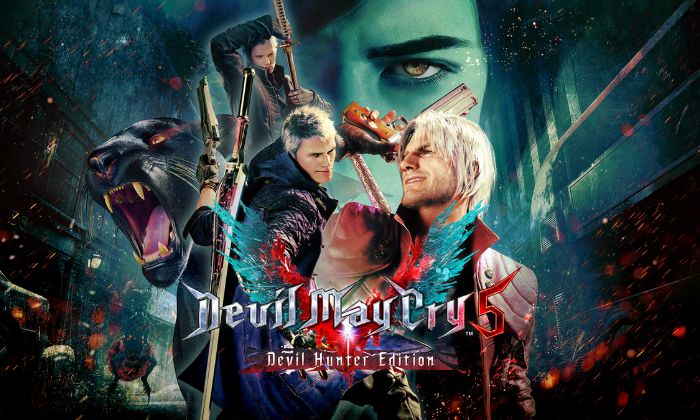
Devil May Cry 5: Devil Hunter Edition – Review
June 25, 2026There’s a very specific feeling that only a few games can evoke: that mix of adrenaline, euphoria, and satisfaction that makes you put down the controller for a second just to process what just happened on the screen. Devil May Cry 5 is one of those rare games, and when Capcom announced that it would be coming to the Nintendo Switch 2 in the form of the Devil Hunter Edition, I confess I felt a mix of anxiety and skepticism. After all, we’re talking about a game that, when it launched back in 2019, was already technically demanding, full of particle effects, dynamic lighting, and chaotic battles with dozens of enemies on screen at the same time. Would the Switch 2 be able to handle it without compromising what makes this game so special?
After hours and hours of playing both in handheld mode and connected to the TV, I can say that this question was answered quite satisfactorily, with a few caveats that deserve attention. Devil May Cry 5: Devil Hunter Edition is a compilation that includes the base game, the Vergil DLC already unlocked from the start, plus a series of cosmetic extras such as alternative costumes, additional music tracks, new Devil Breakers for Nero, and behind-the-scenes videos of the game’s production. It’s not the most complete version that has ever existed for this demonic adventure, since some features exclusive to the Special Edition were left out, but what’s here is already enough to justify the purchase, especially for those who haven’t yet experienced it.
The story of Devil May Cry 5 revolves around a threat unlike anything Dante and Nero have ever faced. A demonic being called Urizen invades Red Grave City and plants the Qliphoth, a gigantic demonic tree that begins draining humanity’s life energy to fuel its power. Dante and Nero attempt to stop the creature’s advance early on, but are defeated with frightening ease. While Nero manages to escape alive, Dante is left behind, seemingly out of commission. Determined to rectify this situation, Nero teams up with the mysterious V, a frail-looking man with enigmatic behavior, to track down Dante and confront Urizen once and for all.
The narrative is presented in a non-linear fashion, alternating between different points in time and different perspectives of the three protagonists, and although this may sound confusing at first glance, everything fits together very well as you progress through the missions. There are moments of genuine humor, which are a trademark of the franchise, but also dramatic twists that truly surprise. Classic characters like Trish and Lady reappear, and the rivalry between Dante and Vergil, present since the first game, gains one of its most impactful chapters here. For those already familiar with the series, the experience is one of well-executed fan service. For newcomers, the game offers a recap video in the main menu that summarizes previous events in the franchise, which is very helpful, even if it’s not entirely comprehensive.
Mechanics and Gameplay
If there’s one thing Devil May Cry 5 does better than almost any other game in the genre, it’s making the player feel stylish even when they’re clearly getting beaten up. The combat system is layered, and the satisfaction of mastering each layer is something few games can replicate. You start the first missions thinking you more or less understand what you’re doing, and then the game gradually introduces new elements until you realize you’re in the middle of absurd combos that you don’t even know how they started.
Nero is the most accessible of the four available characters, and that’s probably why he’s the protagonist of the first campaign missions. He uses the Red Queen sword and the Blue Rose pistol as the basis of his combat, but his big differentiator in this version of the game is the Devil Breakers, mechanical arms developed by Nico, his mechanical partner. Each arm has a unique ability: Overture unleashes powerful electrical discharges, Gerbera fires energy blasts that also serve to reposition Nero in the air, Ragtime manipulates time around enemies, and there’s even a Mega Buster directly inspired by Mega Man that fires three charged shots in rapid succession. The catch is that the arms are fragile: using their special attack, taking a hit while using them, or intentionally activating an explosion for a more powerful effect will destroy the arm and move on to the next one in line. This creates constant resource management that makes each decision in combat more significant than it seems at first glance. And yes, the grapple that allows you to pull enemies towards you or throw yourself towards them is still present and remains absolutely delightful to use.
Dante is where the game’s complexity truly comes into play. He has four combat styles that can be switched at any time using the controller’s directional pad: Trickster focuses on dodging and mobility, allowing you to quickly reposition yourself on the battlefield; Swordmaster enhances melee attacks and unlocks new, unique attacks for each weapon; Gunslinger does the same with firearms, allowing for much more elaborate shooting sequences; and Royalguard is focused on defense, with a blocking system that absorbs enemy damage and allows you to unleash that energy back in a devastating counter-attack. Furthermore, Dante has a vast arsenal that grows as you progress through the game, including swords, boxing gloves, heavy firearms, and some creative surprises that I prefer not to spoil here. Switching styles and weapons in real time to create unique combat sequences is one of the richest and most satisfying experiences the action genre has to offer.
V is a completely different story. He is physically frail and doesn’t directly attack enemies. Instead, he commands three demonic familiars: Griffon, a mocking raven that performs ranged attacks with lightning and projectiles; Shadow, a panther that executes quick and brutal melee strikes; and Nightmare, a colossal golem that enters the scene alone and causes enormous destruction around it. V’s dynamic is basically: use the familiars to reduce the enemies’ health until they are white and stunned, and then approach with V’s cane to deliver the final blow that eliminates them definitively. This creates an experience that resembles a real-time resource manager, requiring you to monitor the positioning of your familiars, keep V safely at a distance, and choose the right moment to attack. At first it feels uncomfortable and even frustrating, but once you find the right rhythm, it becomes something unique and addictive. It is undeniable, however, that the sections marked with V are the least visceral of the main trio, and that the feeling of disconnection from the immediate action is real.
Vergil, available from the start in this edition at no additional cost, is an extra character tied to a side campaign that revisits the same stages of the main game with different cutscenes and a different narrative perspective. His fighting style is based on precision and speed, with the Yamato katana as his main weapon, the Beowulf gauntlets for powerful melee strikes, and the Mirage Blades for ranged attacks with energy projectiles. He can summon a clone of himself to amplify his combos, and his execution speed is absurdly satisfying once you master the rhythm. It’s fair to say that Vergil’s campaign has little narrative content of its own and functions more as a post-game add-on than a standalone story, but playing as him makes up for any script limitations.
The style rating system, which ranges from D to SSS depending on the variety and quality of your combat, constantly encourages experimentation. Repeating the same attack repeatedly will lower your score, so the game naturally pushes you to explore everything each character has to offer. This, combined with a diverse cast of enemies and bosses with unique patterns that require adaptation, results in a campaign that rarely feels repetitive.
Graphics
Seeing Devil May Cry 5 running on a Nintendo Switch 2 is, without exaggeration, one of the most impressive experiences I’ve ever had with a port on that platform. Capcom’s RE Engine has been adapted with remarkable care, and the result is a game that remains visually very appealing, especially considering the hybrid nature of the console.
In portable mode, the surprise is real. The character models are rich in detail, with faces that convey expression and costumes that have texture and visual complexity. The animations are extremely fluid, and the game’s art direction, with its dark and chaotic visual style that mixes devastated urban elements with demonic organic structures, holds up very well on a smaller screen. Red Grave City, even in ruins and taken over by the Qliphoth, has a strong visual identity that impresses on any screen size.
In TV mode, the leap in quality is noticeable. The lighting is sharper, the ambient textures appear more clearly, and details that go unnoticed on the portable screen become evident on a larger screen. We’re not talking about a game that will compete with PS5 or Xbox Series X versions in terms of raw graphical fidelity, but the presentation is consistently good and never looks ugly or dated.
There are some visual limitations that need to be mentioned. The hair rendering of some characters is clearly simplified compared to what was seen on more powerful platforms, and in certain scenes with a lot of action and simultaneous particle effects, the quality of some textures drops slightly. In portable mode, these imperfections are less noticeable simply due to the compatible screen size, but on a 4K TV they become a little more evident, especially in cutscenes, where a slight jaggedness appears more frequently. This doesn’t significantly compromise the experience, but those who have played on next-gen platforms will notice the difference.
Sound
The soundtrack of Devil May Cry 5 is one of the game’s most striking elements, and thankfully it arrives complete and with all its impact on the Switch 2. The game uses a dynamic music system that evolves as the battle progresses: when you start a fight, the soundtrack begins more subdued, and as you chain combos and increase your assessment style, the music gains layers and becomes more intense. When you are in SSS (Single Score), the track is at its peak. It’s a relationship between audio and gameplay that few games execute so well.
Each character has their own theme and musical style. Nero has more intense and direct tracks, with heavy guitars and aggressive vocals. Dante has something a bit more varied and extravagant, reflecting his more charismatic and irreverent personality. V has tracks with a darker and more atmospheric feel, and Vergil receives music that combines power and elegance in a way that only he could achieve.
The sound effects are excellent. Every hit has an impact you physically feel, and the sonic differences between each character’s weapons and styles help to make each one’s identity even more distinct. The English voice acting is very good, with performances that competently balance the drama and humor of the story. The game also features Japanese voice acting for those who prefer it, and both options work very well with the type of narrative Devil May Cry offers. The Devil Hunter edition also includes additional musical tracks that can be selected to replace the originals at certain points, which is an interesting extra for the most dedicated fans.
Fun
If there’s one word to sum up my experience with Devil May Cry 5: Devil Hunter Edition, it’s rewarding. Every hour invested in the game transforms your ability to play in a tangible way. In the first missions with Dante, for example, I found myself basically using two or three attacks because that’s all I could process. A few hours later, I was switching styles and weapons mid-jump to create sequences I didn’t even know were possible. And this learning curve is incredibly fun.
The boss battles are one of the game’s highlights, with epic confrontations that test everything you’ve learned up to that point. Each boss has unique attack patterns that demand different strategies and force you to master the mechanics of the character you’re using in that mission. Some of these confrontations are genuinely memorable and even cinematic in their execution.
The variety between the three protagonists’ playstyles keeps the campaign’s pace very dynamic. Just when you start to feel comfortable with Nero, the game puts you in control of V and completely changes the logic of combat. When you’re getting the hang of V, it’s time for Dante to enter the scene with all his complexity. This alternation is very well balanced throughout the missions and prevents the game from becoming monotonous.
The main campaign lasts around 12 to 15 hours depending on your pace and how much you explore the optional content, but the game is designed to be played multiple times. After finishing the story, you unlock new difficulty modes, including absurdly challenging options that will crush you in ways you never imagined. The Bloody Palace, an arena survival mode, is also present and is the perfect place to test the limits of what you’ve learned. And of course, Vergil’s campaign adds several more hours of extra content.
For those who have never played the series before, there is the option to activate Automatic Combos, which simplifies the controls so that complex attacks can be executed with a single button. It’s an honest entry point, but I strongly recommend learning the actual controls, because the satisfaction of executing a combo manually is incomparable.
Performance and Optimization
This is probably the most important topic for anyone considering buying this specific version of the game, so I’ll go into detail here. Capcom promised 60 frames per second in both handheld and docked modes, and overall this promise is kept very satisfactorily, with some reservations.
In handheld mode, the performance is impressive. Playing Devil May Cry 5 on a handheld screen at 60fps is something I didn’t expect to work so well. The most chaotic battles, with multiple enemies, particle effects, and simultaneous explosions, maintain the necessary fluidity for the combat to feel responsive and precise, which is exactly what a game of this type needs to work. Occasional drops occur in more open sections or with many dynamic elements on the screen, but they are rare and isolated.
Interestingly, in docked mode, the situation is slightly less stable than in portable mode, although it’s still very good. The resolution and visual quality noticeably increase, but this comes at a small cost in terms of framerate stability in more intense situations. Nothing that compromises the experience, but it’s a valid observation for those who plan to play mainly connected to the TV.
The cameras deserve a special mention, and not necessarily a positive one. In more enclosed environments and narrow corridors, they can be positioned in somewhat inconvenient ways, especially during more frantic combat. You can adjust them manually with the right analog stick, but at certain times the camera seems to develop a mind of its own that can slightly obstruct the view of what’s happening.
It’s worth mentioning what’s been left out compared to the Special Edition previously released on PS5 and Xbox Series X. The Legendary Dark Knight mode, which drastically multiplied the number of enemies on screen to create something closer to a Musou-style action game, is absent here. The Turbo mode, which increased the game speed by 20%, is also not present. Ray tracing support and the 120Hz option also didn’t make it to the Switch 2. It’s reasonable to assume that these omissions exist for performance reasons, and that including these features would compromise the overall stability of the game, but these are losses that prevent this version from being called definitive.
Conclusion
Devil May Cry 5: Devil Hunter Edition for Nintendo Switch 2 is one of the best demonstrations of what the platform is capable of doing with a demanding title. Capcom has once again proven that it knows how to adapt its games to Nintendo hardware without sacrificing what really matters: the fluid, responsive, and satisfying combat that is the essence of everything Devil May Cry represents.
For anyone who has never played Devil May Cry 5, this edition is simply essential. Here you have one of the best action games ever made, running excellently both on the couch and in the palm of your hand, with a varied and well-developed cast of characters, a story that captivates and moves you at the right moments, and a combat system with enough depth for months of exploration. The presence of Vergil unlocked from the start, at no extra cost, is a considerable bonus that adds hours of content and one of the most fun characters to control that I’ve ever had in my hands.
For veterans who have already completed the game on PS5 or Xbox Series X, the equation changes slightly. The absence of Legendary Dark Knight and Turbo mode are real losses for those who appreciate these experiences, and the inferior visual fidelity compared to those versions will be noticeable. The main argument for this version, in this case, is portability: the idea of being able to carry Devil May Cry 5 in your bag and play a mission anywhere is very appealing, and the portable mode delivers this with genuinely impressive quality.
It’s a game that’s seven years old but doesn’t feel its age. The exaggerated style, the charismatic characters, the humor balanced with moments of genuine drama, and above all, the unparalleled feeling of executing a perfect combo and watching the screen explode with effects while the soundtrack reaches its peak—all of this remains as fresh and exciting as the first time. This Devil Hunter Edition may not be the definitive version of the game, but it’s certainly one of the most accessible and enjoyable ways to experience it.
Is it recommended? Without hesitation. If you have a Switch 2 and haven’t yet met Nero, Dante, V, and Vergil, now’s your chance.
Positive points:
- A deep, varied, and incredibly satisfying combat system to master.
- Four playable characters with completely distinct styles that guarantee a lot of replayability.
- Vergil is available from the start at no additional cost.
- Very solid performance, especially in portable mode.
- A dynamic and exceptional soundtrack that evolves along with the combat.
- A well-structured story with charismatic characters and genuine plot twists.
- Abundant extra content, including additional costumes, music, and weapons.
- Epic and memorable bosses that fairly test your skills.
- Accessibility options for beginners without compromising depth for veterans.
- Excellent character models and striking art direction.
Negative points:
- Legendary Dark Knight mode is absent compared to the Special Edition.
- Turbo mode has also been removed in this version.
- Cameras exhibiting problematic behavior indoors and during intense combat.
- Vergil’s campaign has little original narrative content and reuses phases from the main campaign.
- Visible jagged edges in cutscenes when in docked mode on larger TVs.
- Some occasional framerate drops in more open sections.
- This is not the most complete version available for those who have already played on PS5 or Xbox Series X.
- V may seem disconnected and less satisfying compared to the other characters.
Rating:
Graphics: 8.0
Fun: 9.5
Gameplay: 9.5
Sound: 9.5
Performance and Optimization: 8.5
FINAL SCORE: 9.0 / 10.0