![Revolution Arena [English Version]](https://revolutionarena.com/english/wp-content/uploads/sites/4/2024/07/Revolution-Arena-ISSN-2966-2117.png)
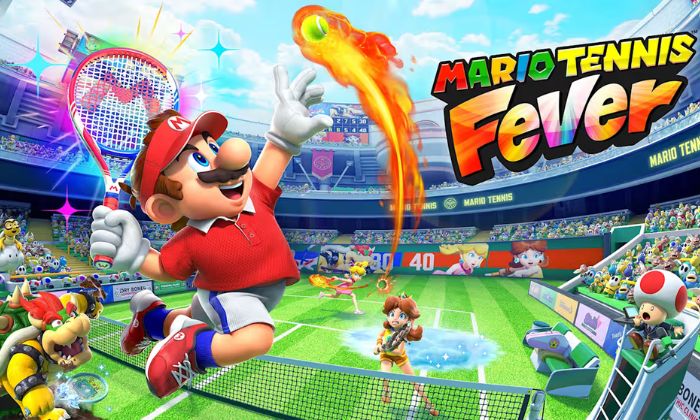
Mario Tennis Fever – Review
February 13, 2026I confess that whenever a new Mario sports game comes out, I go in with two expectations battling in my head. The first is the expectation of delightful chaos, the kind of match that starts with “let’s just do a quick set” and ends with the whole room screaming because someone just turned around an impossible point with an absurd move. The second is the expectation that, since we’re talking about Switch 2 and a series that has already had some truly sharp moments, maybe now comes that episode that mixes fun and technique without having to choose a side.
And that’s exactly where Mario Tennis Fever got me. Because it’s simultaneously one of the Mario Tennis games with the most little things to play with and one of the most frustrating when I try to take it seriously as a “tennis game.” The feeling I got playing it was that I was facing a game that desperately wants to be the ultimate arcade sports title for everyone, but to achieve that, it softens the edges too much. And tennis, even in the Mario style, needs edges. It needs risk. It needs that tension of “if I try to force this parallel shot, I could win beautifully… or send it out and embarrass myself.”
Here, the approach is different. Fever is a game that seems to say, “Relax, I’ll take care of it,” placing you in a safe zone where mistakes are rare, the spectacle is constant, and the main ingredient doesn’t come from the score, but from what’s happening on the court floor. And that choice defines everything. It defines why it’s brilliant on a night with friends. It defines why it can be tiring in long solo sessions. It defines why the game’s great novelty is fun and, at the same time, a magnet for imbalance, visual confusion, and moments when you lose without feeling like you “really” lost.
I played quite a bit of the whole package, went through Adventure mode, hunted down unlocks, delved into alternative modes, and also tested matches with and without the new mechanics. And what I found was a game with a party atmosphere, a showcase look, but with a single-player campaign that stumbles and a sports core that, by design decision, sacrifices some of the impact that made the series shine when you wanted to play seriously.
Mechanics and Gameplay
The core of tennis in Mario Tennis Fever remains that easy-to-understand arcade formula that works in minutes. You have the essential strokes, ball variations with different behavior, and a rhythm that prioritizes quick reading and reaction. It’s the kind of game where you pick up the controller and, without any tutorial, you already understand the basics: hitting, aiming, returning, varying. But when I started playing paying attention to the “tennis” behind the “Mario,” I quickly realized two things: the game is very competent at making the rallies flow smoothly and very persistent in not letting you pay dearly for mistakes.
The classic shots are here and they work well, with enough options to make you feel like you have some strategy beyond just pressing any button. I can alternate between a straighter, stronger shot, a more sliced shot, a shot with a higher bounce, and use a lob to push the opponent to the baseline and a drop shot to bring them back forward. There’s also a timing and power component that gives that “perfect hit” feeling, especially when you hit a loaded topspin and hear the more robust impact sound. The problem is that, despite the tools available, the match often doesn’t put you in that classic tennis situation where you think, “If I overdo it here, it’ll go out.” In Fever, I felt the court was too permissive. The lines seemed too wide. The ball seemed too “well-behaved.” And that changes the mindset of the entire game, because instead of building the point with fear of error and respect for precision, I start playing almost like a game of pushing the opponent from side to side, hoping they’ll become disorganized, since the court rarely punishes me.
The star attraction, of course, is the Fever Paddles . There are 30 paddles with special abilities, each offering a type of effect ranging from direct hazards on the ground to buffs and tricks that change your court coverage. I played with paddles that spread fire, others that make ice slippery, those that throw paint on the net and make you play instinctively, those that fill the ground with banana peels, one that changes the ball into a fast Bullet Bill-style projectile, and even those that create some kind of defensive aid, like a “clone” to cover space. The variety is real and, as a toy, it’s delightful. It’s the kind of system that makes you want to try “just one more” combination, especially in doubles, because then the chaos becomes an event.
Fever works with a bar that fills up during rallies. When it’s full, you activate a Fever Shot on the return, with a small window to aim where the ball will land. The clever thing about the system is that many offensive effects only trigger when the ball bounces. So there’s a mini-duel within the duel: I activate it, you try to return it before it bounces to reflect the misfortune back, and suddenly we’re in a net exchange trying to prevent the bounce as if our lives depended on it. When it works, it’s incredible. When it doesn’t, it becomes “why am I playing tennis in a war zone?”.
However, Fever also presents some very clear problems. The first is balance. Some rackets are clearly more useful than others, and you can feel that a large part of the arsenal exists more for humor than for practicality. I quickly realized which effects dominate most matches, whether by obstructing vision, occupying court space with hazards for too long, or simply causing damage in a way that gets out of control. And the second problem is readability. When four players in a doubles team start using Fever in sequence, the court becomes a carpet of mud, ice, fire, and confusion. It’s funny, but it can also become the kind of situation where you get hit and think, “Okay, but I could have done something, or was it inevitable?” And when the game falls into this inevitability, tennis loses its charm.
This point connects to another very striking choice: the HP bar . Yes, the game puts life into tennis. When you take enough damage from Fever’s effects, your character suffers penalties. In singles, I felt it more like a temporary slowdown and loss of control over the rhythm. In doubles, there’s that cruel moment when someone is out for a few seconds and their partner has to shoulder the burden alone, which can turn into a flurry of points. This creates dramatic and funny moments, but it also makes the game lean more towards “item fighting” than “tennis.” And I think that’s exactly the intention. But then the question becomes: if the intention is to party, the game could fully embrace it and offer better party tools, like a random racket option . I was able to choose a random character and court, but not the racket, and that’s a missed opportunity because randomizing rackets would be the perfect way to make matches unpredictable in a fun way, especially when there are people who don’t know the meta.
Speaking of meta, the game has 38 characters , each with stats and some quirks that attempt to differentiate styles. I enjoyed testing several, and yes, some stand out. There’s a large, slow character who benefits greatly from rackets that increase coverage, an agile character who handles slippery courts better, and some with specific, “stronger” strokes or faster charging speeds. But, in the middle of the roster, I’ll be honest: many blend together. I clearly noticed the difference between extremes, but among the “balanced” ones, I felt a uniformity that doesn’t match the size of the roster. And there’s also the feeling that some are too good for their own good. In certain matchups, I kept thinking, “Why does this character have almost everything high and practically no relevant weaknesses?” This, along with Fever, increases the risk of online play becoming a festival of obvious choices.
Now, if there’s one thing I loved about the idea, even though I found the execution uneven, it was the variety of modes. Besides the basics, there’s Tournament, challenges, modes with crazy rules, and a kind of “tower” of tests that gave me that vibe of event challenges, with specific situations and a quick objective. There’s also Swing Mode , with motion control on the Joy-Con, and it’s fun because of the curiosity and the “party” aspect, but I felt it didn’t demand as much as I wanted. At times it seems responsive, at others it becomes a strange middle ground where you don’t know if you’re fighting against the opponent or against the interpretation of the gesture. It works for laughs, not for precision.
And finally, Adventure mode. The idea is fun on paper: Mario, Luigi, and company become babies, lose stats, need to relearn, there’s an academy, minigames, tests, quizzes, and a map afterward. In practice, for me, it’s the epitome of a “game that doesn’t trust you’ve learned.” The first half is a long, repetitive, and sometimes even silly tutorial, as if I’d never seen a tennis racket in my life. I understand that the game wants to be an entry point for children and beginners. But it overdoes it. It repeats explanations, repeats tests, repeats minigames, repeats conversations. And the saddest part is that when you finally “graduate” and the game starts doing more creative things with tennis, like bosses and different situations, it ends too quickly. I finished feeling that the campaign has good ideas, but the pace is completely inverted: it spends too much energy on the basics and rushes too much when it gets interesting. And there’s another detail that annoyed me as a fan of progression-based games: you increase stats, but you almost never feel that it’s a result of your choices. It’s all kind of automatic, like the RPG is just a sticker on the packaging.
Graphics
Mario Tennis Fever is an undeniably beautiful game. And it’s beautiful in the Nintendo way of being beautiful, with colors that burst onto the screen, characters with exaggerated expressions, animation with personality, and courts that look like living toys. I wouldn’t call it a gigantic generational leap, but I would call it polished and pleasing to the eye almost all the time. The kind of game that looks great on both TV and handheld because the art direction holds up well.
The best visual aspect, for me, is the characters. There’s a level of care in small details that makes you want to keep choosing people just to see the animation. There are clothes with well-defined textures, mustaches with more “volume,” victory poses that look like they were designed for memes, and creative touches for characters who, in theory, shouldn’t even be playing tennis. When I saw how certain characters handle the racket in a way adapted to their bodies, I laughed and thought, “Okay, this is a video game.” That part is really good.
The courts also have a cool visual variety. There are more traditional stadiums, themed courts, things inspired by more “Wonder” ideas, variations with different materials, and some have background elements that bring the scenery to life. I particularly enjoy it when a sports game manages to convey a sense of world, with an audience, screens, movement, and Fever does this well. However, at the same time, I felt that some of the Adventure mode scenarios are bland in comparison, as if the campaign received less attention in the “playable” part than in the cutscenes.
Speaking of cutscenes, this is where the game surprises. Some CGI scenes are of very high quality for a sports spin-off, and I kept thinking, “Why aren’t there more of these?” They elevate the story, add energy, and make the campaign seem more important than it actually is in gameplay. When the campaign reverts to dialogue boxes and repetitive instructions, the contrast becomes even greater.
The only visual drawback I noticed is that not every model looks equally refined. Some characters shine, while others, depending on the lighting, look “strange,” as if the material isn’t calibrated as well as it should be. It doesn’t ruin the game, but being a Switch 2 exclusive, I expected greater consistency across the board, especially when compared to other major Nintendo games.
Sound
The soundtrack for Mario Tennis Fever does its job: it keeps the pace, energizes the match, and has that “Mario sports” flavor with grand and lively themes. I didn’t find myself humming it as if it were the definitive theme of the year, but I also never felt that the music got in the way. The problem is that, in matches with a lot of Fever, so much happens that the music becomes background noise. And honestly, that’s kind of inevitable when you have ink, fire, ice, and bananas all vying for your attention at the same time.
The sound effects are more important here than the soundtrack, and they do a great job of providing feedback. The sound of a perfectly timed, powerful hit is satisfying. The “clack” of the racket, the impact of the ball, the sounds of hazards activating—all of this creates that interactive toy feeling that Mario Sports has always known how to deliver.
Now, let’s talk about the part that annoyed me more than I’d like to admit: the “narration” and the characters speaking. There’s a commentator in the form of a talking flower who spouts phrases constantly, and after a while, it becomes torture. It’s not that the idea is bad. It’s that the repetition kills. I heard the same lines so many times that I started predicting the dialogue before it even happened, and that was it. And the most unbelievable thing is that I managed to turn off the commentary in some contexts, but in others it seemed like the game simply decided, “No, you’re going to hear me.” In tournaments and parts of the campaign, this constant presence becomes a burden. Added to that, Toad appears as an instructor, guide, manager, examiner, and everything else, so his repeated sounds can get tiring quickly. I like Toad. I just didn’t need fifty Toads with the same energy in sequence explaining lob to me as if it were quantum physics.
One positive aspect for the Brazilian audience is that the game has localization, which greatly aids comprehension, especially when Adventure mode insists on teaching rules and details. It doesn’t solve the pacing problem, but it reduces friction.
Fun
I’m going to separate “fun” into two versions, because Mario Tennis Fever feels like two games living on the same cartridge. Version 1 is me alone, trying to extract a loop of progression and challenge from the game that will keep me hooked for weeks. Version 2 is me with people at home, controllers passing from hand to hand, and someone inevitably yelling “I didn’t see the ball, it was all black with ink” while taking a point.
In version 2, the game is very good. It’s funny, noisy, chaotic, and accessible. It becomes the perfect game for get-togethers, families, and groups of people who play a lot and people who hardly play at all. Fever, even when it’s unfair, becomes a story to tell. Swing Mode becomes a ready-made joke. The themed courts become “let’s just try this one out.” And the unlocking system, despite being simple, gives that dopamine feeling of “one more game and I unlock more stuff,” which keeps the group in the rotation.
In version 1, it falters. The Adventure mode, for me, is the classic example of content that exists to justify “it has a campaign,” but doesn’t sustain the game as a substantial solo experience. It has creative moments towards the end, including bosses and challenges that make you use the shoes in different ways, but you spend so much time in the tutorial that you arrive exhausted when it finally gets good. And when you finish, the feeling is “okay, now what?”. There are modes like Tournament and Trial Towers, and I even think Trial Towers is one of the best ideas in the solo package, precisely because it creates short challenges with specific rules and forces you to adapt. But even there I felt it could be bolder, more difficult, more rewarding, with more towers, more run variety, more reason to come back.
Another point is that the game has a “very casual” side that can be a dream for some and a nightmare for others. Because it’s difficult to make mistakes and because the game protects you, some of the tension of a sport disappears. I found myself playing long rallies that seemed to last by inertia, and then Fever would charge, someone would unleash an absurd spin, and the point would end due to chaos, not construction. This is fun in small doses, but in long sessions I started to miss matches where I won through precision and reading the game, not by “who placed the volcano in the right spot”.
In online play, when I faced good opponents, the story changes a bit. Then more strategy, more mind, more intention become involved. And the important detail is that the game lets you choose ranked matches with or without Fever, which is great because it creates two very different experiences. Without Fever, it’s “cleaner” and you can better see the engine of tennis. With Fever, it becomes a competitive party, almost a game of items, with volley counter-attacks and risky decisions more visible. The thing is, even without Fever, there are still strong patterns, like net play with very open slices and the permissive court with rare “outs”. So I wouldn’t say that the classic mode becomes a technical simulator. It just becomes a more readable arcade game.
In the end, I had a lot of fun, but in a specific way. It’s the kind of game I see as “bringing you to game night,” not as “my addiction of the month.” After a while, I started to feel satisfied, as if the game had delivered what it had to deliver and that was it. For an expensive release, that feeling is significant.
Performance and Optimization
Mario Tennis Fever is, for the most part, very smooth. It aims for 60 fps and usually hits the mark. Even with a lot of effects on the screen, the game tends to maintain stability during what really matters, which is the rally happening and you needing to react. Loading is also fast, and that makes a difference in a game with short matches, because you enter and exit the loop painlessly. This type of optimization is what makes multiplayer work well in practice, since nobody wants to wait for a screen when the room’s energy is high.
That said, I noticed some hiccups. In split-screen doubles matches, I noticed occasional drops in performance, especially moments before the serve, like a slight preparation stutter. And I also noticed that, in some contexts, the game slightly slips up precisely during the serve or the instant the point “restarts.” It’s not something that ruins the experience, but it’s curious because it seems to happen at a specific moment, not in the midst of total chaos. Overall, when the show is going well, it holds up. When it’s “setting up the stage,” sometimes it flickers.
Online, my experience was good when I managed to get matches, but that’s always server-dependent and player-based. What I can say is that, structurally, the game offers the features you want: ranked, singles and duos, options with and without Fever, private rooms, and flexibility to play in groups. It also has local GameShare support , which is a lifesaver for convincing someone who doesn’t own the game to play with you without any hassle, as long as they have a Switch 2.
Conclusion
Mario Tennis Fever is the kind of game I can recommend with a smile… as long as I know who you’re going to play with. Because it’s great when you treat it the way it wants to be treated: a tennis party game, full of effects, visual gags, and chaotic matches where the score is only half the story. The Fever Rackets are the real spice, and when the match turns into a volley contest to reflect spin before the bounce, the game delivers moments that only a Mario Tennis game could deliver. The cast of 38 characters is large and fun to explore, the alternative modes bring creative ideas like themed courts and challenges, and the presentation is beautiful, fluid, and full of personality.
However, the game is also a package that “plays it safe” too much. The court is too forgiving, the risk of making a mistake is low, and this removes tension and reward from precision. Fever, in turn, is fun, but has balancing problems, effect duration issues, and an excess of information in doubles, creating situations where losing seems inevitable, undeserved. The Adventure mode, which could be the glue for those who play alone, starts with a long and repetitive tutorial, has quizzes and minigames that get tiring, and when it finally gets creative, it ends quickly and leaves little reason to revisit. And the talkative flower commentator, along with the incessant presence of characters guiding you, goes from “charm” to “please, silence” much faster than it should, getting even worse precisely in the modes where I wanted a more focused experience.
So, to put it bluntly: I recommend Mario Tennis Fever if your intention is to play with friends, family, at parties, get-togethers, or if you want an easy-to-learn arcade game full of chaos to laugh together. I don’t recommend it at full price for those who want a memorable solo campaign, a heavier and more precise arcade tennis game, or a game that will become your competitive hobby of the year. It’s fun, it shines in a group, it’s technically competent, but it lacks that “something extra” that transforms a good spin-off into an instant classic.
Positive points
- Beautiful visuals full of personality, with great animations and elaborate cutscenes.
- Creative and highly entertaining multiplayer game called “Racket Fever,” featuring counter-attack moments and real tension in the volley.
- A good number of different modes and ideas, with Trial Towers standing out as a solo challenge.
- Large roster with 38 characters and lots of content to unlock by playing.
- Performance is generally solid at 60 fps and loading times are fast.
Negative points
- Adventure Mode is slow-paced at the beginning, overly tutorial-heavy, and ends just when it starts to get really interesting.
- The physics and “weight” of tennis can seem too light, with little punishment for errors and little risk in rallies.
- The balance of the Fever rackets is inconsistent, and the chaos can turn into an illegible mess, especially in doubles.
- Talking flowers and repetitive comments get tiring, and in some modes it’s impossible to mute them completely.
- Some modes and progressions feel shallow, with unlocks often based solely on “playing X matches”.
Rating:
Graphics: 8.3
Fun: 7.6
Gameplay: 7.2
Sound: 6.9
Performance and Optimization: 8.0
FINAL SCORE: 7.6 / 10.0
Facebook Comments