![Revolution Arena [English Version]](https://revolutionarena.com/english/wp-content/uploads/sites/4/2024/07/Revolution-Arena-ISSN-2966-2117.png)
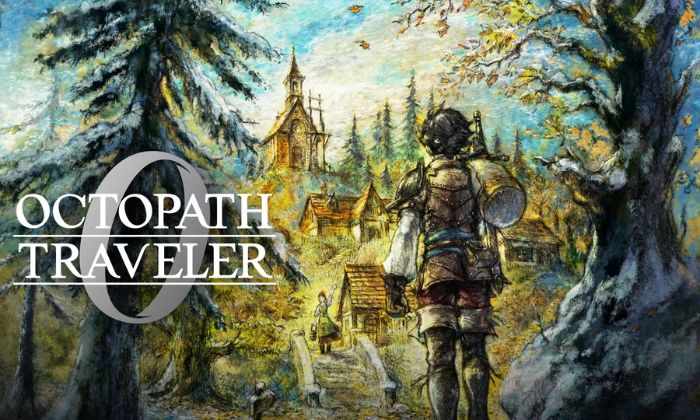
Octopath Traveler 0 – Review
December 4, 2025Octopath Traveler 0 is the kind of game that, when you start “just to test it out,” you suddenly realize that eight hours have passed, you’ve forgotten about everything else, and you just want to do “one more quest.” I played the Nintendo Switch version 2 and, honestly, it had been a long time since a JRPG so classic in format, but so modern in its ideas, had captivated me like this.
The premise is simple on the surface, but it works very well: you create your own character, a resident of the small and welcoming town of Wishvale. It’s that typical RPG village, full of friendly people, a festive atmosphere in the air, everything seeming perfect. Until three absolutely detestable figures, each representing an extreme of wealth, fame, and power, appear in search of a divine ring and simply destroy everything. The city crumbles, people die, and your character survives carrying this ring that, in a way, chose you.
From there, the game drops you into Orsterra with two clear, major objectives: hunt down those responsible for destroying your home and rebuild Wishvale from scratch. Revenge and reconstruction. Darkness and hope. This contrast is the emotional foundation that drives Octopath Traveler 0, and it’s what hooked me right away.
This structure already shows that, unlike the first two games, this one doesn’t have that format of eight loose protagonists, each with their own “separate” story. Instead, everything revolves around you, the “Ringbearer,” and a smaller group of main characters who truly grow throughout the adventure, such as the architect Stia, the hunter Phenn, and the priestess Laurana. They aren’t just extras on your path; they are the emotional heart of the journey.
But don’t worry: despite the more focused narrative, Octopath Traveler 0 is huge. Really huge. The main campaign easily surpasses 100 hours if you get carried away by the side stories, the city building, and the absurd number of characters you can recruit. And the most impressive thing: despite some ups and downs in pacing here and there, the game rarely feels like it’s “padding.” There’s always something concrete to do, a clear objective, a hateful villain to confront, a bizarre or charismatic character to meet.
Let’s talk about everything in parts, because there’s a lot going on here.
Mechanics and Gameplay
Octopath Traveler 0 is, at its core, a very traditional turn-based JRPG: you walk around maps, explore cities, talk to NPCs, accept quests, engage in random combat in open areas or dungeons, level up, buy better equipment, and face bosses that will crush your party if you slip up. But on top of this classic framework, the game stacks several layers of systems that fit together surprisingly well.
Eight characters in battle: the real Octopus
The most important change in gameplay, without a doubt, is the eight-character simultaneous battle system. It works like this: you assemble a party with up to eight members. Four are in the front line, four in the back line.
In practice:
- Front: acts on the turn, takes hits, uses skills, spends BP, etc.
- Backwards: it recovers gradually (HP, SP), accumulates BP and becomes protected, ready to enter the right shift.
On any given turn, a frontline character can instantly switch with their backline partner. And that completely changes the way you think about combat.
When assembling your team, you start thinking in “pairs”: that tank warrior paired with a burst damage mage. A healer alongside a fast attacker. A debuffer who prepares the ground, with someone behind ready to come in and finish things off. And the game greatly rewards those who think about this synergy.
The feeling is that of assembling a team of “duos” instead of just putting four strong players on the front line. This opens up space for tactics such as:
- Leaving a vulnerable player in the back row accumulating BP, only to step in at the exact moment and take down a broken boss.
- Swap someone who’s almost dying to the back line, while pulling in another resourceful character to hold the fort.
- Use swaps as part of your strategy: there are abilities that give extra bonuses if you swap in that turn.
At the same time, the game doesn’t descend into uncontrolled chaos because the foundation remains the familiar combination from the series: a system of weaknesses and shields (Break) and a Boost Points (BP) system.
Break & Boost: a classic from the series, still addictive.
The combat system follows the “Boost & Break” pattern:
- Each enemy has a number of shields and a list of weaknesses: weapons and elements.
- By attacking with the right type of attack, you reduce this shield. When it reaches zero, the enemy enters a Break state: they lose their action for that turn and the next, and take significantly more damage.
In addition, each character accumulates BP each turn (up to a limit). You can:
- Spend BP to attack multiple times at once.
- Spend BP to boost spells and abilities.
The dance of combat is always about balance:
- When is it best to use BP to break the shield quickly?
- When is it best to save BP to blast the enemy when they are broken?
With eight characters participating in the fight (four active and four in reserve), it becomes even more strategic because you have much more coverage of weaknesses: swords, spears, axes, bows, daggers, firearms, light, shadow, fire, ice, wind, lightning… In more complicated boss fights, I felt it almost became a tactical puzzle: “if I save the BP here, switch that mage forward this turn and use the multi-hit ability, I’ll break the boss before he unleashes the devastating attack”.
It’s the kind of system that starts simple, but the more skills you unlock, the more combos start to appear. I had several moments of absolute satisfaction when, after three or four well-planned turns, I saw the boss being obliterated with a sequence of turbocharged skills, everyone spending BP together.
Character customization: freedom with some restrictions.
One important difference compared to the first two Octopath games: here, only the protagonist can change classes. All other characters have a fixed and unique class. This may seem like a limitation, but the game compensates in other ways.
Its protagonist:
- You have access to the eight classic jobs (warrior, thief, merchant, hunter, cleric, mage, dancer, apothecary).
- You can switch jobs outside of combat, which allows you to cover gaps in your team.
- You can also learn skills from various jobs and serve as a “wild card”.
The other characters:
- They have a fixed job, but each one brings a specific set of skills, passive abilities, and even their own “ultimate” ability.
- Even two characters of the same class are not clones. One warrior is more focused on defense, another on raw damage, another on multi-hit, for example.
And that’s where the “Masteries” system comes in (which the game treats as mastered skills):
- As you spend Job Points (JP) to learn all the skills of a class on a character, you can spend more JP to “master” certain skills.
- Once mastered, that skill becomes a type of “skill item” that can be equipped by other characters in specific slots.
This means that, over time, you can create hybrids: for example, giving an area heal to a character that was originally focused on single-target healing, or giving an elemental multi-hit to someone who didn’t have access to that. It’s not as free as the sub-job system in previous games, but it still provides a really nice range of build possibilities.
In practice, I felt that:
- The protagonist is the Joker.
- The rest of the team is made up of specialists with a few touches of versatility thanks to Masteries and passive abilities.
If you enjoyed breaking the system in Octopath 1 and 2 until you turned a character into an absurd destruction machine, here it’s a bit more restrained, but it’s still entirely possible to put together some pretty overpowered combinations, especially towards the end of the game when ultimates come into play.
Ultimates, Helpers, and Path Actions
In addition, there are:
- Special Techniques (Ultimates):
Each character gains an ultimate ability that charges up during battles. It’s like a super move that, when the bar fills up, you unleash and completely change the course of the fight. It’s very satisfying to save an ultimate for the exact moment when the boss is in Break and watch their health bar melt away. - Helpful NPCs:
You can recruit NPCs in cities to fight alongside you as limited-use “summons” in battle. Some heal, others deal heavy damage, and others apply status effects. It’s not the core of the gameplay, but against more annoying bosses, it can be the difference between winning and being obliterated. - Path Actions:
Back in the series, but with an important difference:
Only the protagonist performs path actions (stealing, bargaining, inquiring, inviting to Wishvale, challenging to a fight, etc.).
The chance of success depends on three global attributes: Wealth, Fame, and Power.
As you complete quests and solve stories, these attributes increase, unlocking access to better items, NPC secrets, new villagers for Wishvale, and so on.
The result is that talking to NPCs isn’t just about “lore”: often, you’re interested in what that citizen can bring to your city, or the item recipe they drop, or the skill they unlock.
The world, exploration, and mission structure.
After the prologue, the game opens up to four initial lines:
- A plot of revenge against the Master of Power.
- A revenge plot against the Mistress of Wealth.
- A revenge plot against the Master of Fame.
- Plot for the reconstruction of Wishvale.
You’re relatively free to follow the path in any order you want, respecting the level recommendation for each region. This gives the game an almost “anime arc” feel: each route with its own characters, its prominent villain, and its recurring supporting characters. When you finish these three main arcs, the game throws you into a large subsequent saga that delves deeper into the consequences of everything that happened.
Exploring the map is a lot of fun. It’s still the route system connecting cities, with branching paths to dungeons, caves, forests, and ruins. And there’s that classic feeling of: “hmm, level 24 area and I’m level 18… should I risk peeking just to see what’s in the chest back there?”. Spoiler: you often get beaten up, but when you succeed, there’s that delicious mini-victory.
If there’s one area where the gameplay feels a bit weak, it’s:
- Frequency of random encounters: sometimes it’s fight after fight, with only a few seconds of walking between them.
- Duration of some fights, especially against mid-bosses and elite enemies: some fights last much longer than they need to, even if you are at a level above the recommended level.
For those who love grinding and deep turn-based combat, this is a real treat. For those with less patience for long battles, it can get tiring at certain points.
Graphics
Visually, Octopath Traveler 0 continues the spectacle of HD-2D that has become a trademark of Square Enix, but with one important detail: it’s not on the same technical level as some of the more recent examples of this style, such as some Dragon Quest remakes. Still, on the Switch 2, the game is very beautiful.
Scenery, lighting and atmosphere
The scenery is the highlight: stone villages surrounded by forest, scorching deserts, rich cities full of gold and moral decay, ruined fortresses, snow-capped mountains with snow falling in real time… Everything has that diorama look, as if you were looking at a living model.
Some points that deserve attention:
- Lighting effects: torches illuminating walls, reflections in the water, sunbeams piercing through trees, magic exploding on the screen and tinting everything red, blue, and gold.
- Small animated details: leaves swaying, snow falling, smoke rising from chimneys, flags waving, water running.
- Subtle camera changes during battles, creating that pseudo-3D depth effect.
On the Switch 2, when playing on the TV, all of this appears in 1080p at 60 fps most of the time. In handheld mode, the sharpness is excellent, and the pixel art works really well with the smaller screen.
Characters and enemies
The main characters are 2D sprites with plenty of personality: victory poses, attack animations, skill effects. It’s not hyper-detailed, but it’s expressive. In boss fights, the game really comes alive: giant enemies, bizarre designs, distorted human figures symbolizing greed, vanity, and arrogance. These bosses have that “JRPG boss art” look, which makes an impact as soon as they appear on screen.
If I had to point out one visual drawback:
- Some floor textures and simpler objects reveal the mobile origin of some of the assets.
- On very large TVs, certain elements may appear slightly blurry, especially when compared to more recent HD-2D games that were designed with top-tier console hardware in mind from the start.
Nothing that ruins the experience, but if you pay close attention to sharpness, you’ll notice.
Overall, Octopath Traveler 0 remains one of those games that makes you want to stop every now and then, put the controller down, and just stare at the screen for a few seconds.
Sound
If there’s one thing this series never gets wrong, it’s the soundtrack. And this was no different.
Music
Octopath Traveler 0 Mix:
- New songs composed specifically for this story.
- Themes reused and rearranged from previous games and the mobile version.
This means that:
- If you’ve played the others, you’ll recognize some themes with new orchestrations, sometimes grander, sometimes more understated.
- If this is your first time experiencing it, you’ll only realize that the trail is excellent from beginning to end.
Highlights:
- Themes featuring main villains with intense, sometimes almost theatrical arrangements that match how detestable they are.
- Calmer exploration songs, with that road trip vibe, adventure and melancholy.
- Battle themes that accelerate at just the right time, especially in boss fights, where the soundtrack layers as the combat progresses.
It’s the kind of soundtrack that you finish the game and you’re still humming it or remembering some of the melodies.
Sound effects and dubbing
The sound effects are a good complement:
- Sword strikes with satisfactory impact.
- Spells with well-defined sonic explosions.
- Interface with “clickable” sounds that make everything responsive.
Regarding the dubbing (in English):
- The main characters are very well portrayed, especially the villains and more dramatic figures.
- Some supporting characters have a slightly exaggerated or caricatured performance, but within the almost theatrical narrative style that the game embraces, it works.
The text and interface are 100% in English. The game does not have Portuguese subtitles, and the language used is not simple: it has a sophisticated vocabulary, medieval fantasy expressions, and speeches full of pomp and formality. For those who are not confident in their English reading, this can be a real obstacle.
Furthermore, the audio work is, at the very least, excellent. It’s the kind of game that deserves to be played with good headphones or a well-adjusted TV sound.
Fun
This is where Octopath Traveler 0 truly shines. Fun is subjective, but playing it on the Switch 2, I was genuinely impressed by how long this game held my attention for hours on end.
The narrative: more coherent, darker, more addictive.
The great strength lies in how the story is structured. Instead of eight somewhat disconnected protagonists, we have a more cohesive main narrative with well-defined arcs:
- Story arcs focused on each main villain, exploring themes of wealth, fame, and power taken to the extreme.
- The Wishvale reconstruction arc, which is slowly transitioning from tragedy to hope.
- A grand subsequent arc ties everything together, expanding the scale of the threat and the impact of their actions.
The villains, by the way, are some of the most hateful I’ve ever seen in recent JRPGs. It’s not just “oh, he’s evil because he’s evil.” They do bizarre, cruel, disturbing things, sometimes in an almost “Game of Thrones” pixel art style. There are genuinely heavy moments involving torture, abuse of power, fanaticism, misogyny, and a thirst for fame. All of this gives much greater weight to the feeling of revenge: when you finally take one of them down, it’s truly cathartic.
At the same time, the game isn’t just about misfortune. The reconstruction of Wishvale is a much warmer narrative thread: reuniting with survivors, dealing with trauma, seeing people rebuilding their lives, forming a new community. You become attached to that town. When Wishvale reaches a new level and the music changes to a more epic and hopeful theme, it’s the kind of moment that takes you by surprise emotionally.
Wishvale: More than just a minigame
The city reconstruction deserves a special mention for its fun features. It’s not a complex, hardcore simulator-type building system. In fact, it’s relatively simple:
- You clear debris, you free up space on the city map.
- Use resources (wood, stone, etc.) to construct buildings: houses, shops, taverns, arenas, farms, training areas.
- Invite NPCs from around the world to live there, placing each one in a house.
The cool part is that almost all of this connects to the rest of the game:
- Houses and their inhabitants generate environmental items, passive buffs, resources, store discounts, XP and JP bonuses, a higher chance of rare items, etc.
- Farms produce cooking ingredients for dishes that grant temporary buffs in battle.
- Training allows characters who are not in the party to gradually gain levels.
- Specific structures unlock extra systems, such as a monster arena, mobility tweaks, and travel features.
You can simply do the bare minimum and follow the story. Or you can dive in headfirst, try to optimize who lives where, which bonuses fit your play style, and make the city visually the way you like it. I found myself several times pausing the main progression just to “finish fixing up” a neighborhood in Wishvale.
Content volume and pacing
The fun also comes from the fact that the game almost always has something interesting to offer:
- Want to focus on the story? There’s always a large arc to follow.
- Want a break from the heavy narrative? Go farm resources, explore a cave, hunt a powerful monster.
- Want to shake things up on your team? New characters are popping up all the time, ready to be recruited.
- Just want to wander around the world? There’s always a side quest, a quirky NPC, a secret hidden around the corner.
Of course, not everything is perfect. Here are some things that might spoil the fun for certain players:
- Slow start: the game takes a good few hours to really get going and show just how good it can be.
- The middle of the game can feel tedious if you try to do everything at once, especially due to the excessive number of random encounters and lengthy battles.
- An absurd number of recruitable characters can be tiring, both to manage and to see that many of them will not have much narrative relevance.
But, weighing it all up, for me, the overall enjoyment was very positive. It’s the kind of game that stays with you for weeks, in long weekend sessions and shorter gaming sessions in portable mode.
Performance and Optimization
Playing on the Nintendo Switch 2, Octopath Traveler 0 performs very well.
Frame rate and resolution
- In docked mode:
The game runs at 1080p, targeting 60 fps. Most of the time, it achieves this goal.
In scenes with more effects or in some more demanding areas, you can notice occasional performance drops, but nothing that ruins or makes the gameplay choppy. - In portable mode:
The resolution is adjusted to maintain fluidity, and visually it looks excellent on the Switch 2 screen.
The frame rate remains stable most of the time, with occasional brief stutters in very specific situations.
Since we’re talking about a turn-based JRPG, small frame rate drops don’t impact gameplay responsiveness like they would in a frenetic action game. But it’s good to know that, for this type of game, the performance is quite solid.
Loading times, stability, and interface.
- Loading times between areas are relatively short, especially when compared to giant JRPGs from past generations.
- I didn’t encounter any freezes, crashes, or serious bugs during my playthrough. No broken quests or corrupted save files.
- The interface is responsive, menus open quickly, and navigating between skills, equipment, and characters is relatively easy, even with the huge roster.
The only “optimization” point that weighs against it, but isn’t technical, is the text localization: there’s no Portuguese option, and the volume of dialogue is insane. This can be seen as poor “target audience optimization” because it automatically alienates a large portion of Brazilian players who don’t speak English.
Technically speaking, however, Octopath Traveler 0 on the Switch 2 is very well served: fluid, beautiful, and stable.
Conclusion – Is Octopath Traveler 0 worth playing?
After many hours with the game on the Switch 2, my feeling is clear: Octopath Traveler 0 is, indeed, one of the best modern classic JRPG experiences available today.
It takes everything that worked well in the previous games:
- Combat based on weaknesses, Break and BP, with that delicious tactical flavor.
- Jaw-dropping HD-2D aesthetics.
- The soundtrack is absurdly good.
And it improves areas that were previously more problematic:
- The narrative, now more cohesive, features a central protagonist and well-developed recurring characters.
- The sense of progression in the world, with arcs that truly change the face of Orsterra and Wishvale.
- The depth of combat with eight active characters, Masteries, Ultimates, and the dynamic forward/backward switching.
At the same time, it’s not a perfect game. It has clear problems:
- The complete absence of localization in Portuguese, coupled with difficult text, is a significant blow to the Brazilian audience.
- The difficulty curve is sometimes strange: at the beginning it may seem too easy, but later on some bosses become insurmountable.
- Random encounters are frequent and, in certain regions, last far too long.
- The city-building system, while fun and meaningful, could be more profound, less limited in decoration and layout.
Despite this, overall the game delivers:
- A massive campaign, with over 100 hours of content.
- A story full of impactful moments, memorable villains, and powerful themes.
- A combat system among the best in the genre today.
- A world that makes you want to explore and revisit.
For whom:
- He likes classic JRPGs.
- Enjoy deep and strategic turn-based combat.
- She loves modern pixel art aesthetics and good soundtracks.
- Don’t be intimidated by a long, complex game full of systems.
Octopath Traveler 0 is highly recommended.
If you’re not fluent in English, however, unfortunately the recommendation becomes complicated: the game’s appeal depends heavily on the story, dialogue, and nuances of the text. Without that, you can still enjoy the combat and visuals, but you’ll miss a huge part of the experience.
Still, looking at it as a game critic, evaluating the whole package, for me Octopath Traveler 0 is one of the most important and interesting JRPGs of this generation, and a great highlight in the Switch 2 library.
Positive Points
- Extremely deep and satisfying turn-based combat, with eight characters on the field and many strategic possibilities.
- A refined Break & Boost system that transforms every battle into a mini tactical puzzle.
- A wide variety of playable characters, each with unique abilities, passives, and ultimates.
- The possibility of customizing the protagonist with all eight main jobs, serving as the team’s wildcard.
- A Mastery System that allows you to share skills between characters and create interesting builds.
- A fun, meaningful, and emotionally engaging reconstruction of Wishvale.
- A more cohesive and focused narrative, with strong villains, mature themes, and truly impactful moments.
- Excellent soundtrack, mixing new themes and rearrangements, always perfectly suited to each moment.
- Beautiful HD-2D visuals, with gorgeous scenery, good use of lighting, and stylish battle animations.
- Lots of content: long main campaign, many side quests, characters to recruit, secrets, and optional dungeons.
- Good exploration options, with a sense of a world transforming as you progress through the story.
- Stable performance on the Switch 2, with 60 fps most of the time and acceptable loading times.
Negative Points
- There is a complete absence of Portuguese text, with sometimes complex English, making the game inaccessible to many Brazilian players.
- Uneven difficulty curve: very easy initial sections and some difficult peaks further on.
- Random encounters are very frequent and, in some cases, fights last longer than necessary.
- The job-changing system is limited to the main characters, offering less freedom than in previous games to transform the entire cast.
- The reconstruction of Wishvale, while fun, is a bit simplistic in terms of depth of construction, and limits the number of simultaneous decorations and buildings.
- The sheer number of recruitable companions can lead to fatigue when managing equipment, levels, and skills, and results in many of them having limited space in the main narrative.
- Some visual assets reveal the mobile origin of some of the material, falling slightly short of other more recent HD-2D games.
- A relatively slow start, with the “good part” of the story and systems only showing their full potential after several hours of gameplay.
Rating:
Graphics: 8.8
Fun: 9.2
Gameplay: 9.5
Sound: 9.3
Performance and Optimization: 9.0
FINAL SCORE: 9.2 / 10.0
Facebook Comments