![Revolution Arena [English Version]](https://revolutionarena.com/english/wp-content/uploads/sites/4/2024/07/Revolution-Arena-ISSN-2966-2117.png)
Pokémon Pokopia – Review
March 4, 2026Pokémon Pokopia is the kind of game that, if you had told me about it a few years ago, I probably would have turned my nose up at. A Pokémon spin-off without battles, without traditional captures, focused on real-time gameplay, building, and cozy living? It sounded like “just another cute game I’d try out of curiosity and abandon after a few hours.” But the exact opposite happened. As soon as I started this game, I completely lost track of time digging blocks, building habitats, carrying a team of construction worker Pokémon, and taking care of the comfort of creatures that, until yesterday, I only chose based on their attack points. Pokopia is one of the most daring, well-rounded, and addictive projects the series has ever had…
The idea is simple, but very effective: you control a Ditto that wakes up alone in a completely destroyed, dry, and silent part of Kanto. Humans have disappeared, Pokémon have disappeared, the city that you soon realize is Fuchsia has become a ruin. The only “inhabitant” is a Tangrowth who takes on the role of Professor and explains the basics: the world has become uninhabitable, things have deteriorated, everyone has left. The only chance to bring life back is to restore the environment, block by block, blade of grass by blade of grass, until Pokémon feel comfortable enough to return. From there, the game drops you into large maps, full of scorched earth, broken buildings, garbage, pollution, and secrets, and says: “go, fix this up.” But it does so with so much personality, care, and variety that, suddenly, “fixing this up” becomes your new fixed hobby.
The heart of Pokopia lies in this well-balanced contrast between cuteness and melancholy. On the surface, everything is pastel, rounded, fun, full of smiling Pokémon calling you friend, wanting to play hide-and-seek, jump rope, and take quizzes. Between the lines, the notes you find scattered across the map, the yellowed newspapers, the research records, and the ruins of places you recognize from the Game Boy era tell a much heavier story: how humans pushed the world to its limits, how the climate got out of control, how coexistence gradually imploded. Nothing is thrown in your face, there’s no dramatic text, but if you take the time to read and explore, you’ll piece together a puzzle that’s far more serious than the cute visuals suggest. And this combination works incredibly well. You play smiling, but at various moments you let out a “wow” when you understand what happened in a certain place.
All this with a protagonist who, honestly, has never shone so brightly. I always treated Ditto as that pink mass that’s good for breeding and that’s about it. In Pokopia, it becomes the perfect hero. It assumes a human form inspired by the missing trainer (which you customize), but it never stops being a Ditto: ball eyes, fixed smile, blank expression, strange hands, somewhat clumsy way of running. When it copies a move, the details appear: Squirtle’s tail, Bulbasaur’s green vine arms, Lapras’ body for Surf, the belly and horns of another Pokémon when it learns to roll and destroy rocks. If it falls from a great height, it turns into a puddle of goo and returns. If it stops to rest, sometimes it melts back into the ground and sleeps in its original form. It’s the first time in a game in the series that I really felt like I was playing as a Pokémon, not just controlling “a creature with a HUD”.
And it’s with this package that Pokopia starts to hook you. A destroyed world, a quirky Ditto as the protagonist, a somewhat clumsy Professor Tangrowth, and the mission to rebuild Kanto in a way that seems like an unlikely mix of Animal Crossing, Dragon Quest Builders, Minecraft, and Viva Piñata. It seems like a lot to take in at once, but in practice it becomes a well-structured whole, with a pace that only picks up after a really slow start. Let’s take it one step at a time.
MECHANICS AND GAMEPLAY
The gameplay of Pokémon Pokopia revolves around a loop that, on paper, seems simple, but in practice becomes a giant web of systems: creating habitats, attracting Pokémon, learning skills, using those skills to reshape the world, building structures, increasing the comfort of areas, unlocking more items and missions, repeating this in different biomes, and still fitting into all of this cooking, planting, electricity, fluids, gathering, side quests, endgame, multiplayer, and your own island for you to play architect.
It all starts with habitats. Instead of throwing Poké Balls, you “summon” Pokémon by creating specific combinations in the environment. Four blocks of grass together become a tall grass habitat that can attract Kanto starters. If you place that same area against a tree, it becomes a shady tall grass area that might attract a Scyther or a Bellsprout. A circle of flowers in a cemetery area can attract ghosts. A dark corner of a cave with damp rocks and little movement becomes an ideal home for Zubat and company. These habitat recipes are recorded in a Habitatdex, which works almost like an environmental puzzle book: it gives you a visual clue, sometimes a name, and it’s up to you to understand the combination of blocks, furniture, and location that will make that creature appear.
When a new Pokémon appears in an area, the game never treats it as just another number in the Pokédex. It appears with a personality, talks to you, makes an initial request that usually involves improving that corner of the world, teaches a move, or reveals its “specialty.” And then the system opens up. The “Transformations” are abilities that Ditto learns by copying specific Pokémon: Water Gun to irrigate soil and revive trees, Leafage to create grass and moss where there was only dry earth, Rock Smash to break blocks, Cut for pruning and cleaning, moves that manipulate fluids, electricity, vertical movement, even the ability to glide or roll, destroying entire corridors of rock. That’s how the map opens up. There are places you see early on, but can’t reach until you get the right ability, and returning later with a more complete kit is always enjoyable.
In addition to this, Pokémon aren’t just skill keys. Each one has at least one specialty associated with work: Build for construction, Burn for refining and fire, Water for heavy cleaning, Grow for cultivation, and so on. When you start a larger project, such as rebuilding a Pokémon Center or erecting a monument, a “technical sheet” appears requesting X units of certain raw materials and a list of required specialty types. You literally assemble a construction team with the Pokémon that live in the area, call them to follow you, take them to the construction site, place materials at the base, assign each one to a function, and start the process. After 10 minutes, an hour, or even the next day (in the case of large structures), you return and find the building finished. This feeling of co-authorship is very strong: you’re not just placing a finished building from the menu, you’re coordinating Pokémon laying concrete walls, firing bricks, nailing wood, and clearing debris.
And it doesn’t stop there. Many Pokémon are also “living factories.” If you leave a Fire-type Pokémon near a furnace, you can drop piles of clay there to turn into bricks, ores to turn into ingots while you’re away taking care of something else. Leaving a Water-type Pokémon at a pollution point and giving it soap activates a mass cleaning of dirty blocks, which you can then complement with a Water Gun. Some are great for farming, accelerating crop growth. Others are perfect for working at the cash register of a small shop you organize in your city. It’s as if the entire Pokémon ecosystem has finally been translated into a life simulation system with real practical function. I stopped seeing each one only as a “combat build” and started thinking about “who is good for what in my city.”
The other side of this loop is comfort management. Each area has a “Comfort” level and an “Environment Level” that act as a gauge of how well you are taking care of the collective well-being. Setting up a basic habitat is just the beginning. When a Pokémon settles there, it starts asking you for things: a bed, a toy, a closer water source, better lighting, a warmer or cooler temperature, a less noisy space, specific furniture. Some want to move into their own house that you build with blocks and furniture; others want neighbors of a specific type or want to escape noisy ones. Fulfilling these requests increases individual Comfort, which contributes to the area’s Comfort and unlocks new items, recipes, decorations, and even clues to rare habitats at the Pokémon Center terminal. The game constantly encourages you to think not only about “how to make it beautiful,” but “how to make it habitable for the fauna I chose to place here.”
This terminal, by the way, is the hub that ties together a whole bunch of systems. It’s where you see the comfort level, the daily and general challenges of the area (plant X flowers, build Y structures, find Z different Pokémon), buy furniture, blocks and recipes using coins you earn from these tasks, check your collection progress, activate or review habitat tips, monitor your trainer rank, and even manage parts of the online mode. It’s almost an “operating system” for your city, but presented in a very light way, more like a Pokémon smartphone app than an MMO menu.
The entire game is tied to a real-time day and night cycle. If it’s night in your house, it’s night in Pokopia. This isn’t just for visual appeal; several Pokémon only appear at certain times, some activities are more productive during certain periods, and large constructions use the real-time clock to complete. A Pokémon Center might take until the next day to finish, smaller booths might take half an hour. This naturally evokes that “I logged in this morning to see how it turned out” style of gameplay, very similar to Animal Crossing, but with an important difference: whenever I was stuck on a “for tomorrow” construction, there was still something useful or fun to do. Improving neglected habitats, exploring overlooked corners, searching for lore notes, cleaning up pollution, planting, cooking, reconfiguring roads. Instead of feeling pushed out of the game, I felt gently nudged into other parts of the sandbox.
It’s true that the beginning is quite slow. The first area, which is a large, dry steppe, takes a while to unlock the full set of tools that make you feel powerful. In the beginning, you break block by block, water a little at a time, and you don’t yet have access to more advanced fluids, electricity, or mechanisms. It’s understandable that some people get discouraged in the first few hours. But, if you get past this “initial hurdle,” the game enters a very strong crescendo. Suddenly you’re building an electrical grid with Pokémon-powered generators, assembling elevators and cable cars, redirecting waterfalls, cooking recipes that hinder your mining or flying ability, connecting farms in a production chain, and automating part of your ecosystem with Pokémon “employees.”
Amidst all of this, there’s also a giant island of your own for you to use as a personal sandbox, without the pressure of the guided narrative of the main biomes. There you don’t have ruins to restore, just a huge map with several different sub-biomes, ready to receive your version of a peaceful Kanto. You can bring Pokémon from other areas, recreate classic regions, make absurd sculptures using blocks, and build themed cities. And, if you enjoy multiplayer, there’s also a “cloud island” where you and friends can collaborate at different times, like a persistent Minecraft server.
Not everything is perfect. The recipe unlocking system is scattered across challenges, item collection, hidden special Poké Balls, shop rewards, and sometimes the game actually holds onto a specific item you want to complete a habitat or fulfill a timed request, and you have no idea if it will drop from a mission, a box, or a future trade. Inventory control can also be irritating: Ditto has an expandable backpack, you can place chests around the map, but there’s no unified storage. In the later stages, I was already wandering between regions trying to remember in which box I had stored exactly that type of processed ore that a Pokémon wanted. None of this ruins the experience, but these are points where the game could be less rigid without losing its identity.
Even so, looking at the complete package of Pokopia’s mechanics after dozens of hours is impressive. It takes practically everything that makes these great builders and life sims work and reinterprets it in light of the biology, types, abilities, and “moral ecology” of Pokémon. It’s a city simulator, but where its inhabitants are truly treated as species with behavior, not as puppets with random text.
GRAPHICS
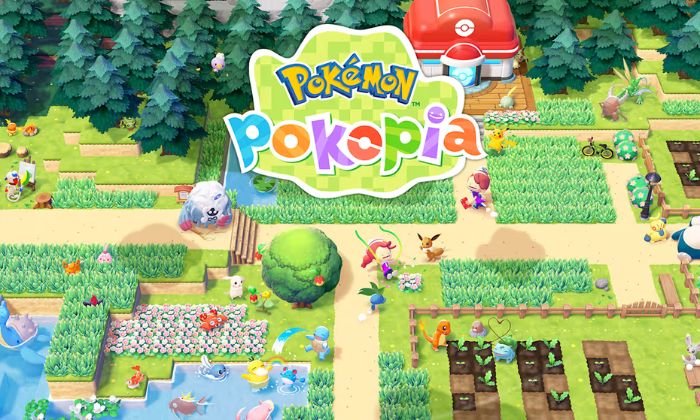
If you’re looking for hyper-realistic graphics, ray-traced reflections on Poké Balls, and Mr. Mime-like fur textures that are terrifying, Pokopia isn’t the game for you. The visual choice here is different: a blocky world that’s still very cute, with everything rounded, colorful, almost “squishy.” The aesthetic mixes a bit of the feel of Dragon Quest Builders with the light touch of Pokémon, but with less hard detail and more focus on smooth, expressive shapes.
The blocks that make up the environment are clearly cubic, like in Minecraft or Builders, but on top of them there are layers of vegetation, trash, rocks, and somewhat broken structures, giving each biome its own unique look. The first area is entirely in sepia, brown, and gray tones, exuding abandonment. As you clean, irrigate, and rebuild, the same place fills with saturated greens, colorful flowers, and sparkling water. A dilapidated beach area begins covered in toxic mud, sewage, and oil. When you finish the job, it becomes that bright bay, with clean sand, revised structures, and peaceful aquatic Pokémon swimming and strolling.
The Pokémon themselves are perhaps the greatest visual triumph. After the graphical missteps of some main games in the series, seeing the little monsters here, running smoothly, with beautiful models, accurate proportions, and animations full of charisma, is refreshing. They smile, run, stumble, dance, sit on benches, playfully fight, and make faces when they receive gifts. Seeing a Bulbasaur drawing a heart with its vines, a Charmander complaining about the dampness, an Oddish burying its face in the dirt, a Piplup getting excited by the water you throw on it—all of this helps sell the idea that they really live there, and aren’t just walking decorations.
Ditto, in particular, is a show in himself. His transitions between human form and goo form, and between the multiple stolen abilities, are full of cool little details. The hand that turns into Scyther’s blade, the hat that appears in a certain shape, the eyes that never change no matter how monstrous the copy is, all of this reinforces the character’s “sweet strangeness.” Several times I stopped just to see how he looked with a specific combination of clothing, accessory, and equipped attack.
The environments offer a good variety of biomes: plains, beaches, multi-story caves, areas suspended in the sky, and extra maps with more open geography. Visually, they don’t try to be hyper-complex, but they play well with height, depth, and layers to give you that feeling of “there’s still something up there” or “what could be behind that wall?”. In some places, you can see pop-in details in the distance, bare blocks being replaced by texture as you get closer, but on the Switch 2 this is quite subtle, more of a natural artifact of large block games than a serious problem.
And then there are the references. Walking through certain ruins and suddenly realizing that the layout of buildings and paths is a classic gymnasium, or an important city from the old games, only completely destroyed, is a very strong feeling. The visual team knew how to balance this carefully: you can feel the “I’ve been here before” without becoming a slave to nostalgia, and without needing to know the original games in depth to appreciate the scene.
Overall, Pokopia isn’t a technical monster, but within the cozy builder genre, it’s visually very consistent, clean, and has a clear identity. I never got the feeling of a “cheap game” or a “half-baked repurposed project.” Everything seems designed to be comfortable to look at for many hours at a time.
SOUND
The Pokopia soundtrack does exactly what this type of game needs to do: provide a pleasant accompaniment without becoming tiresome. Most of the music is mellow, with instruments that strongly evoke the vibe of Animal Crossing, that mix of tranquil keyboards, a little guitar, flutes, and some touches of more melancholic piano in specific areas. Nothing here tries to be epic or a “gym theme,” the idea is to create a backdrop for you to stay in “I’m just going to fix up this little street” mode.
What stands out most, however, are the subtle references to Pokémon music that appear at just the right moments. In certain places and specific times, the game injects re-orchestrated snippets of classic themes, sometimes almost hidden amidst the new composition, sometimes more in plain sight. Entering a certain ruined structure and hearing a slowed-down version of a song you know by heart, but in a sadder tone, perfectly fits the premise of revisiting a broken Kanto, trying to rebuild, but without erasing the traces of destruction.
Furthermore, there are collectible items that unlock special tracks, including remastered versions of older songs. This provides an extra incentive to explore every corner, and even allows you to create a kind of “nostalgic playlist” within the game itself, which was a huge treat for me as a long-time fan.
The sound effects are also very well integrated. The Rock Smash sound on the block, the splash of water falling and covering dry ground, the slurp of Ditto sucking blocks into its inventory, the clack of tools, the sound of footsteps on different terrain—everything conveys physics, weight, texture, even within a cute aesthetic. And the Pokémon sounds, which mix characteristic cries with small voices and contextual grunts, greatly help to bring the community to life. Hearing two Pokémon laughing near a bench, another grumbling because it’s annoyed by the weather, another sighing with happiness when you tidy up its habitat—these are micro-details that remind you to look at them as beings with routines.
Pokopia isn’t the kind of game whose soundtrack will have you whistling it around the house, but it’s the kind of soundtrack that you’ll miss immediately if you turn it off. The audio is an essential part of the “welcoming world” feeling the game wants to create. It never imposes itself, never shouts, but is always comfortably surrounding you.
FUN
Perhaps the coolest thing about Pokopia is how captivating it is without resorting to any cheap daily reward tricks that look like gacha. I’d log in “just to check if the Pokémon Center was ready,” and two hours later I’d still be there tinkering with the details of a staircase, adjusting the position of a tree, connecting two areas with a better path, rearranging Pokémon that were fighting over light. It’s one of those games where the very act of interacting with the world becomes a pleasure, almost like a simulator of “tidying up a virtual room with monsters.”
Its pacing is intriguing. While there’s a clear story with narrative objectives, areas that open up sequentially, the construction of Pokémon Centers, and main missions requiring certain skills and materials, everything is structured in a way that you’re never forced to focus on that straight path if you don’t want to. If you don’t feel like following the request of an “important” Pokémon at that moment, you can simply turn the camera elsewhere and spend the next few hours breaking rocks, cleaning rivers, planting gardens, decorating the homes of random Pokémon, and improving the quality of life of those you like most. The game even gently reminds you of the “next step” from time to time, but it rarely completely paralyzes you because of it.
Of course, in exchange for this freedom, Pokopia fully embraces the profile of a cozy experience. There’s no combat, no real loss, no hard failure. If you jump wrong, you don’t die, at most you turn into goo and come back. If you set up a habitat in the wrong place, you can dismantle it and try again. If you make a mistake in the decoration, move the furniture and that’s it. The most “punishment” is having wasted a little resource or time. For those used to seeing Pokémon as a series about training teams for competitive goals or advancing in gyms, this may sound strange. For those who always wanted to “just live in the Pokémon world,” talk to them without dual-screen battles, see them behaving like animals with routines, Pokopia is practically a fantasy come true.
The fun also comes a lot from the variety of little things you can do. In a long session, I found myself alternating between:
Transforming everything based solely on the Pokémon’s requests in an area, increasing the Comfort level and seeing who reappeared.
Exploring slopes and caves just to see what new views I could find, and if there were any lost golden Poké Balls or lore notes. Playing
puzzle games with habitats, trying to discover recipes without looking at clues, just matching blocks and decorations.
Rearranging the network of paths, bridges, and stairs to make a part of the city more beautiful and practical.
Cooking dishes that buff certain abilities and testing where that would make the most difference.
Simply sitting Ditto on a bench and watching what the Pokémon did on their own.
Is there repetition? Of course. Many Pokémon requests revolve around variations of “give me this piece of furniture,” “I want this type of toy,” “I prefer more light,” “I want a quieter corner.” Many constructions follow the pattern of “gather X materials, arrange Y Pokémon with the right specialty, wait.” At certain moments, you feel like you’ve already seen the format of that “mission zone” in another area, only changing the theme and type of Pokémon requested. But, at least for me, the set of possibilities always spoke louder. Even when I was technically repeating a mission structure, the place where I fitted it, the Pokémon involved, the way that piece of scenery connected to the rest of my city gave it a fresh enough look to not sound like pure recycling.
One detail that adds a lot of flavor to the fun is the number of references scattered throughout. Pokopia is full of nods to the entire history of the series, especially the first generation and its reinterpretations, but always in a “ah, I get it” tone instead of “look, you’ll only understand this if you’ve played everything.” Sometimes it’s a detail in the scenery, sometimes it’s the name of an item, sometimes it’s the music, sometimes it’s a found log that alludes to an event from the old games. For those who have known Pokémon for years, it’s a delight. For those who are just arriving, it doesn’t get in the way at all.
And then there’s the social aspect. Playing Pokopia with friends, whether having them visit your city, collaborating on the cloud island, or entering other people’s worlds, is a different kind of fun. You can work together on large-scale projects, have a lighthearted competition to see who can build the most outlandish house, or just wander around showing off what you’ve built. The multiplayer minigames, like hide-and-seek using Ditto’s camouflage ability, are silly, but they reinforce the playful atmosphere among friends.
Ultimately, the greatest measure of enjoyment for me was how often I kept returning to the game after the credits rolled. Pokopia not only held up throughout the entire campaign without tiring me, but it also left a queue of interesting things for later: habitats I hadn’t yet tested, rare Pokémon I wanted to see in action, regions I wanted to calmly redesign, and large projects for my personal map. And I kept coming back not out of obligation, but simply because it was enjoyable to be in that world.
PERFORMANCE AND OPTIMIZATION
Pokopia surprised me positively in the technical aspect. It’s not that it’s a graphical monster, but it’s stable and well-optimized, which matters a lot in a game that spends so much time with dozens of objects and creatures on screen, blocks being destroyed and placed, water particles, lighting effects, and so on.
When playing docked, the frame rate remains close to 60 fps almost all the time. In more demanding situations, with many Pokémon, structures, falling water, and particles, there may be a slight drop, but nothing that breaks the fluidity or is very noticeable. In handheld mode, the rate drops closer to 30 fps, with adjusted resolution, but everything still runs smoothly enough to play without discomfort. As the visual style is less detailed and more stylized, the impact of this is less than it would be in a game focused on realism.
Loading screens vary depending on the area you’re going to. Several transitions between parts of the same map are subtle, with disguised progressive loading. Fast travel between large biomes or the initial game loading may take a few seconds longer, but overall, Pokopia doesn’t give you the feeling of “waiting for the game all the time.” In practice, what will make you wait between one thing and another is much more the internal timegate of buildings than the black screen time.
The controls have friction points, and this mixes with the perception of optimization. Aiming and placing blocks in a 3D environment with a free camera is never trivial. In Pokopia, the target of your attack or the block to be placed depends on a combination of Ditto’s position, where you are aiming from, and which face of which block is selected. On flat surfaces and at the same level, it’s straightforward. When you want to hit a single specific block three levels above or below, or build details in tight spaces, the “analog stick ballet” begins: move the camera, take a step forward, turn around, try again. After a while you get the hang of it and learn to use some skills and aiming modes that help, but there’s no denying that the experience could be smoother, especially for those already accustomed to the perfect furniture placement scheme in Animal Crossing: New Horizons, for example.
Another aspect that blends design and “quality of life optimization” is the inventory. The game tries to force you to think locally, to take advantage of resources in your area, and not to carry the entire universe in your backpack. Therefore, the lack of a global inventory makes conceptual sense. But, after dozens of hours and with many different materials in hand, this becomes too much work. I had entire sessions dedicated to “organizing storage,” spreading chests in strategic locations, trying to remember a coherent logic, and even then I ended up lost when I needed something specific. A shared inventory system between chests or, at least, a way to search where an item is stored, would work wonders.
Aside from those issues, technically Pokopia is very solid. I rarely encountered serious bugs. Some Pokémon might get stuck in strange geometries if you take very crazy paths, but the game usually has ways to “reset” positioning, and the pathfinding is surprisingly good for a block-based game: seeing the team of helpers going up the cable car as a group, using the elevator in a line, going around obstacles while following you, without constantly getting stuck, shows the team’s care.
CONCLUSION
After all that, it’s easy to answer the question: Is Pokémon Pokopia worth it? In my experience, yes, very much so. But with an important asterisk: it’s a game designed for those who can enjoy building, relaxed repetition, cozy life, creative experimentation, reading texts, and observing details. It’s not for those looking for adrenaline, strategic combat, reflex tests, or a classic RPG campaign.
As a spin-off, Pokopia does something I’ve always wanted to see Pokémon do: stop focusing so much on numbers, damage, competitive tiers, and focus on what it would be like to simply live in a world with these creatures, respecting their needs, their behaviors, their specialties. It takes the ecology that has always been suggested in the main games and supplementary materials and transforms it into a central system, both mechanically and thematically. And it combines this with a builder structure that, on its own, would be strong enough to hold an entire game together.
It’s not perfect. The initial pace is too slow and may scare away a portion of the audience before the game reveals all it has to offer. The Pokémon’s requests sometimes become repetitive, with too many missions of “get this piece of furniture and put it there,” lacking creative variation. The existence of timegates in important buildings is a double-edged sword: it adds a charm of daily routine, but also causes frustration when you’re immersed in the game and just want to move on. The building controls, while functional, could be finer and less “stubborn” in tight spaces. And the inventory is probably the most unanimously criticized aspect, requiring adjustments in future updates.
But even with these problems, I can hardly recall another Pokémon spin-off so complete and so confident in its own identity. It doesn’t try to be “Pokémon with a different skin”; it takes various inspirations and genuinely asks, “How would this work in a world inhabited only by Pokémon and a humanoid Ditto rebuilding everything after a disaster?” The answer, in practice, is an extremely engaging game, full of personality, with content for dozens and dozens of hours, that leaves you speechless seeing a Bulbasaur happy because it got the right bed.
If you love Pokémon, enjoy builders like Dragon Quest Builders, are passionate about decorating islands in Animal Crossing, like spending hours building little worlds in Minecraft, or simply want a relaxing game to fit into your daily routine, Pokémon Pokopia is an easy recommendation. If you like Pokémon but can’t stand the idea of a game without battles or repetitive, cozy tasks, then I would suggest watching some gameplay videos beforehand. Aside from that specific taste, Pokopia is one of the best gifts the series could receive in its 30th year.
Positive points
– Extremely satisfying gameplay loop, mixing building, ecology, comfort, and exploration in a very well-balanced way
– Brilliant use of Ditto as the protagonist, with animations, transformations, and personality that make you truly feel like you’re playing as a Pokémon
– Superbly translated Pokémon ecosystem in terms of mechanics: abilities, job specializations, behaviors, coexistence between species
– Absurd amount of content: multiple biomes, personal island, cloud island, rare habitats, collections, abilities, recipes
– Very well-constructed cozy atmosphere, balancing cuteness with a layer of melancholy and subtle environmental critique
– Pleasant, stable visuals, with very well-modeled and animated Pokémon
– Smooth and competent soundtrack, with occasional and exciting uses of classic themes from the series
– Creative and useful multiplayer, with shared islands and real co-op building
Negative points
– Slow start, which takes a while to unlock the set of tools that make the game truly addictive
– Main structure by biome is a bit repetitive, always revolving around rebuilding Pokémon Centers and completing a pattern of missions
– Block and object placement control can be imprecise, especially in tight spaces or vertical areas
– Inventory and chest system separated by area, without global storage, becomes messy in later stages
– Some tasks and Pokémon requests become repetitive and could have more creative variety
– Timegates in large constructions can frustrate those who want to play marathon-style without stopping
Rating:
Graphics: 8.5
Fun: 9.5
Gameplay: 9.0
Sound: 8.5
Performance and Optimization: 8.5
FINAL SCORE: 9.0 / 10.0


Facebook Comments