![Revolution Arena [English Version]](https://revolutionarena.com/english/wp-content/uploads/sites/4/2024/07/Revolution-Arena-ISSN-2966-2117.png)
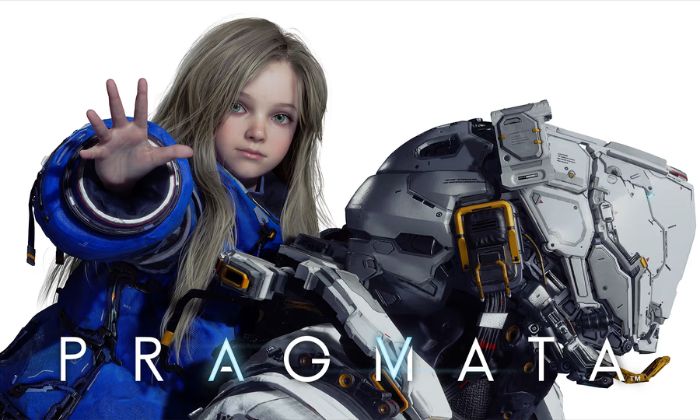
PRAGMATA – Review
April 15, 2026I’m very impressed because I just discovered a game that blew me away! You know that game you didn’t even know you needed, but when you find it, you realize it’s here to change everything? Well, Pragmata is exactly that! When I come across this type of game, I make a point of buying a physical version to add to my collection, which sits on my office shelf, even if I already have the digital copy, and admiring the material, art, etc… …it’s just a huge shame that Capcom released this gem of a game in the unbearable Game Key Card format.
Capcom, already on an incredibly impressive string of hits, has once again surprised me with a brand new IP that made me feel like I was reliving the golden age of gaming (my God, how I loved Capcom games back in the Super Nintendo days!), but with a futuristic twist that screams 2026. I, who was already used to remakes and sequels, was thrown headfirst into a lunar adventure that’s pure adrenaline and excitement. And the best part? This experience arrived on my beloved Switch 2, showing that the platform is more than ready for major releases. If you like science fiction, a good third-person shooter, and a story that grabs you, then come with me, because “Pragmata” is a treat you can’t miss!
Mechanics and Gameplay
Let’s get straight to the point: Pragmata’s gameplay is simply brilliant and, for me, the game’s highlight. Capcom managed to create a combat system that is both familiar and totally innovative. I found myself controlling Hugh, an astronaut who, despite being a great marksman, wouldn’t be able to survive alone in this crazy lunar station. That’s where Diana comes in, the little android who becomes my inseparable partner. The core mechanic is real-time multitasking combat that made me feel like I was playing two games at the same time, but in an incredibly fluid and addictive way.
While I controlled Hugh, dodging attacks, moving with jetpacks, and unleashing my futuristic arsenal on enemy robots, Diana was right behind me, ready to hack. And hacking isn’t just a button you press; it’s a mini-puzzle game that appears on the screen, like a high-speed “Tetris” or “Snake.” I had to aim at the enemy, initiate the hack with Diana, and simultaneously continue controlling Hugh to avoid being hit. It’s a constant dance between shooting, dodging, and solving the hacking puzzle. When the hack is successful, the enemy becomes vulnerable, revealing weak points that I could blast with Hugh’s shots. The satisfaction of dismantling a horde of robots with that kind of synchronicity is indescribable!
The game offers me a variety of weapons that can be customized and upgraded in the Bunker, our safe base. It has everything: shock cannons, grenade launchers, rifles, space shotguns, and even a railgun. Each weapon has its weight and purpose, and I learned to choose the right one for each type of enemy. In addition, Diana also has her own hacking upgrades, with “Hacking Nodes” and “Mode Chips” that allow you to customize the effects of the hacks, such as overheating enemies, dealing more damage, or even confusing them. This depth in the combat system allowed me to experiment with different playstyles and find what best suited my play style.
The game’s progression is very well thought out. I started with basic abilities, but as I progressed and collected materials, I could improve both Hugh and Diana. Each upgrade I bought at the Shelter was noticeable in the gameplay, which encouraged me to explore every corner of the lunar station in search of more resources. The level design, while linear in its essence, is full of side paths, secrets, and “Red Gates” that challenged me with more difficult combat and valuable rewards. And for those who like an extra challenge, the training simulations and New Game Plus are a treat, allowing you to test new weapon combinations and hacks against stronger enemies. It’s a system that kept me engaged from beginning to end, always wanting to see what the next ability I would unlock would be.
Graphics
Visually, Pragmata is a spectacle in itself, and Capcom truly showcased the power of the RE Engine here. I was impressed by the game’s art direction, which manages to blend the futuristic with the organic in a unique way. The lunar station, called The Cradle, is an environment that left me speechless. It’s not just a gray, industrial base; it’s a place teeming with artificial life, with biomes that recreate parts of Earth, like a distorted Times Square or lush forests, all 3D-printed. The contrast between these environments and the desolation of space is simply stunning.
The visual details are incredible. The lighting is fantastic, creating an atmosphere that varies between desolate and hopeful. The character models are very well done, with Hugh and Diana expressing emotions very convincingly. The enemy robots are varied and well-designed, with fluid animations that make them menacing. I found myself several times stopping to admire the scenery, the particle effects, and how the light interacted with the different materials of the station.
Even playing on the Nintendo Switch 2, which naturally has its limitations compared to other platforms, the game manages to deliver high-quality graphics. Of course, there are some compromises, such as slightly less sharp textures at certain points or Diana’s hair physics which can appear a little blurry, but nothing that spoils the overall experience. Capcom did an exceptional job of optimization, ensuring that the game maintained its beauty and visual impact even on the hybrid platform. The art direction is so strong that it compensates for any small loss of graphical fidelity, creating a world that is visually coherent and incredibly immersive.
Sound
The sound experience is as immersive as the visual and gameplay aspects. The soundtrack is impressive, with music that perfectly fits each moment of the game. During exploration and calmer moments, the music is more atmospheric and melancholic, reinforcing the feeling of solitude in space. In combat, the soundtrack becomes frenetic and pulsating, increasing adrenaline and making me even more immersed in the action. The music never overwhelms the scene, but always complements the atmosphere masterfully.
The sound effects are equally remarkable. Every shot, every explosion, every hack by Diana has a distinct and satisfying sound. I could feel the impact of my weapons and the vulnerability of the enemies when Diana hacked them. The sounds of the enemy robots are varied and helped me identify the type of threat I was facing, adding a tactical layer to the combat. Furthermore, the sound effects also served as auditory clues to puzzles and environmental interactions, making exploration even more intuitive.
And what about the voice acting? I played with the Brazilian Portuguese dub, and it’s outstanding! Hugh and Diana’s voices are perfect, conveying all the emotion and chemistry between the characters. Hugh has a gruff but protective tone, while Diana is captivating and innocent without sounding artificial. The naturalness of the dialogues and the quality of the acting made me connect even more with the story and the characters. It’s a localization effort that shows immense care for the player and elevates immersion to another level. Even the voices of secondary characters and AIs, like Cabin and IDUS, are excellent, contributing to the richness of the game’s universe.
Fun
Pragmata is a game that entertained me from beginning to end, and its fun factor is one of its greatest strengths. The combination of innovative gameplay, a thrilling story, and a visually stunning universe kept me glued to the screen for hours on end. With each new challenge, each new upgrade, each new plot revelation, I felt a growing excitement.
The relationship between Hugh and Diana is the heart of the fun. I became attached to Diana in a way I didn’t expect. She’s curious, innocent, and full of life, and seeing the evolution of her relationship with Hugh, who is initially somewhat skeptical, is very rewarding. The moments of interaction between them at the Shelter, where I could give Diana gifts, play hide-and-seek, or simply talk, were welcome pauses in the frenetic action and made me feel like I was building a real bond with the character. It’s a dynamic that avoids the cliché of the “sad father” and leans towards a relationship of unconditional support and love.
The game manages to balance intense action moments with exploration and narrative very well. I constantly felt challenged by the combat, but the reward of overcoming it and seeing the story progress was always very satisfying. The puzzles, while not excessively difficult, add an extra layer of engagement. And the overall atmosphere of the game, which mixes the unsettling with moments of lightness and hope, is something that deeply affected me. “Pragmata” is the kind of game that makes you laugh, makes you think, and makes you feel, and that, for me, is the definition of fun.
Performance and Optimization
Pragmata’s performance on the Nintendo Switch 2 is a true triumph for Capcom. I played the game in both docked and handheld modes, and I was impressed with the optimization. Capcom managed to deliver a fluid and stable experience, even with the graphical complexity and intensity of the action.
In docked mode, connected to the TV, the game runs excellently, with a very consistent frame rate. There were some minor performance drops during moments of intense on-screen action, especially in denser areas like the forest, but these were rare and never compromised gameplay. The resolution is very good, and the game maintains its visual beauty.
In handheld mode, the performance is equally impressive. Although image sharpness is slightly lower and framerate drops are a bit more frequent compared to docked mode, the game is still perfectly playable and fun. It’s incredible to have a game with this level of graphics and gameplay quality running in my hands. Capcom did an exemplary job balancing visual fidelity with performance, ensuring an enjoyable experience in both modes. The use of technologies like VRR (Variable Refresh Rate) in handheld mode helps maintain stability, and DLSS (Deep Learning Super Sampling) contributes to the visual quality.
In short, Pragmata’s optimization on the Switch 2 is an example of how developers can get the most out of the platform. It’s not every day that we see a AAA game, with such impressive graphics and complex mechanics, running so well on a hybrid console. Capcom has proven once again that it is one of Nintendo’s best partners, delivering a game that is a technical delight and proof of the Switch 2’s potential.
Conclusion
Pragmata is, without a doubt, one of the biggest and most enjoyable surprises of 2026. Capcom, with its boldness in launching a new intellectual property, delivered an experience that surpassed all my expectations. This game is not just a third-person shooter; it’s a thrilling journey, a tactical challenge, and proof that innovation still has a prominent place in the video game industry.
The chemistry between Hugh and Diana is the beating heart of the entire adventure. I found myself invested in their relationship, rooting for them to escape that lunar station and learn more about Earth. The way the game builds this bond, not only through the narrative but also through the gameplay, where Diana is an extension of my abilities, is something that deeply affected me. It’s a story of human (and robotic) connection that resonates in a very powerful way.
The gameplay is a spectacle in itself. The hybrid real-time shooting and hacking combat system is addictive, challenging, and incredibly satisfying. With each new enemy, each new area, I felt like I was learning and evolving, mastering a mechanic that, at first, seemed complex, but which became intuitive and enjoyable. Capcom managed to create a game that is easy to learn but difficult to master, with a tactical depth that kept me engaged for more than 15 hours of the campaign, not counting the post-game content.
The graphics are stunning, with art direction that creates a unique and memorable sci-fi universe. The lunar station is a character in itself, full of details and varied environments that made me want to explore every corner. The soundtrack and Brazilian Portuguese dubbing are of very high quality, further enhancing the immersion and emotional connection with the story.
And the fact that all of this runs so smoothly on the Nintendo Switch 2 is the icing on the cake. Capcom has demonstrated impressive technical mastery, delivering solid performance and a visually rich experience, both in docked and handheld modes.
Pragmata is a game that made me laugh, made me think, and made me feel. It’s proof that Capcom is at its peak, delivering not only quality sequels and remakes, but also betting on new ideas that have the potential to become classics. If you’re looking for a game that combines intense action, a captivating story, and innovative mechanics, don’t hesitate. Pragmata is an easy recommendation and one of the best games I’ve played this year. Don’t miss this chance to embark on a lunar adventure that will surprise you from beginning to end. Do it for Diana!
Positive points:
- Innovative and addictive hybrid gameplay combining shooting and hacking;
- An exciting and well-developed relationship between Hugh and Diana;
- Stunning art direction and graphics;
- High-quality soundtrack and voice acting (in Brazilian Portuguese);
- Excellent performance and optimization on the Nintendo Switch 2;
- Intelligent level design and rewarding exploration;
- Depth in the characterization of Hugh and Diana;
- Original and captivating story;
- Post-game content and replayability.
Negative points:
- Some bosses may seem like “damage sponges” on certain difficulty levels;
- The hacking mechanics can be a bit overwhelming in very frantic moments;
- The story, while good, may be a bit predictable for veterans of the sci-fi genre;
- Minor framerate drops in Switch 2’s handheld mode in dense areas;
- The linear structure may not appeal to everyone who expects an open world;
- The physical version doesn’t have the game saved on the cartridge; it uses the insufferable Game Key Card.
Rating:
Graphics: 9.5
Fun: 9.5
Gameplay: 9.0
Sound: 9.5
Performance and Optimization: 9.0
FINAL SCORE: 9.3 / 10.0