![Revolution Arena [English Version]](https://revolutionarena.com/english/wp-content/uploads/sites/4/2024/07/Revolution-Arena-ISSN-2966-2117.png)
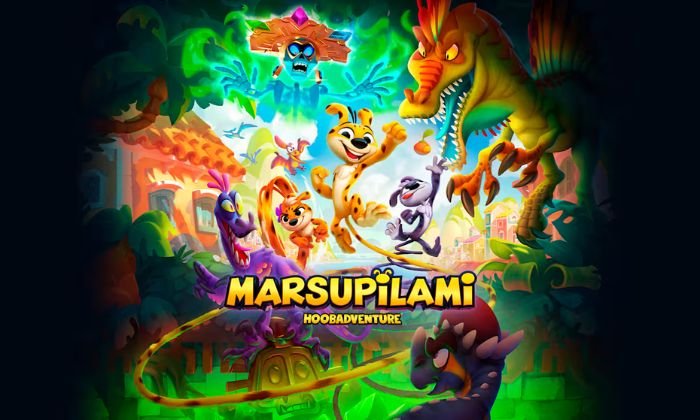
Marsupilami: Hoobadventure – Review
June 4, 2026I confess that when I first heard about Marsupilami: Hoobadventure, my reaction was pure doubt. The name is long, complicated, and the main character is a fictional creature from a Franco-Belgian comic book that many people of the current generation don’t even know. But, believe me, this was one of those moments when the universe conspired to prove to me how wrong I was to underestimate something. As soon as I turned on the game and started playing, I realized I was facing something special, one of those titles that appear out of nowhere and give you a huge dose of quality.
Marsupilami is a character that has existed since 1952, created by André Franquin for the pages of Spirou magazine, a famous publication in France and Belgium. The creature gained popularity with the Brazilian public mainly because of an animated series that aired on free-to-air television in the late 90s and early 2000s. So, yes, there’s a nostalgic weight here for those who grew up during that time, but the game goes far beyond that. It manages to win over even those who have never heard of the character before, and that’s quite an achievement.
The game’s story features three Marsupilamis named Punch, Twister, and Hope, who live peacefully on the island of Palombia until, during a game on the beach, they accidentally open a sarcophagus and release an ancient, grumpy spirit. This ghost begins to curse all the animals on the island, controlling their minds. Luckily, the Marsupilamis are immune to this power, so it’s up to the trio to embark on an adventure to save everyone and send the spirit back to where it came from. The narrative is simple, very simple even, and there’s practically no story development throughout the game. The cutscenes between levels are few and far between, and there are no subtitles or voice acting, making it difficult to understand what’s happening without seeking information outside the game. It’s a shame, because the character’s universe has a lot of potential for a more elaborate story. But, as happens in the great classics of the platforming genre, the narrative serves only as a pretext for what really matters: running, jumping, and exploring.
Developed by Ocellus Studio and published by Microids, Marsupilami: Hoobadventure is a 2D platformer with 3D models, the style that people call 2.5D, and was released in November 2021 for PlayStation 4, Xbox One, Nintendo Switch, PC, and Mac. I bought this game in a great sale on the Switch eShop and from the first moment I got my hands on it, I was overcome with a pleasant feeling of playing something carefully produced, with attention to every detail. If you also enjoy platform games, you really need to check out this marsupial adventure.
Mechanics and Gameplay
Marsupilami’s gameplay is the beating heart of the game and, thankfully, it’s where it shines brightest. From the very first minutes, it’s clear that the controls were designed with great care and precision. The Marsupilamis move quickly, fluidly, and responsively, and the feeling of control is excellent from beginning to end of the adventure.
The control scheme is quite accessible. With just a few buttons, it’s possible to perform a surprising variety of movements. The characters run, jump, climb walls, and use their tails in very creative ways. This gigantic tail is the game’s star mechanic. With it, you can attack enemies like a punch, hang from fixed or rotating rings scattered throughout the levels, propel yourself upwards to gain extra height, perform a diving attack to break boxes and chests on the ground, and even transform into a kind of spinning wheel to gain speed in a frantic race through the levels. This last ability is especially fun because you can keep rolling indefinitely by repeatedly pressing the button, and it can also be combined with an air jump to gain horizontal distance. Learning to chain all these movements together naturally is very satisfying, and the game teaches you all this gradually and intuitively throughout the levels.
The influences are clear, and the game doesn’t try to hide them. Any Donkey Kong Country fan will instantly recognize the toucans that function exactly like the barrels in the Rare classic, spitting you out in the direction they’re looking when you press the button. The birds that launch you across the scenery are one of the most exciting moments in the game, especially when you chain several together at high speed. It also has Crash Bandicoot DNA, with the timers that activate after completing each level and invite you to replay the level in the shortest time possible. And the world structure with secret levels, hidden collectibles, and hidden bonuses is very reminiscent of the tried-and-true formula of great 2D platformers of all time.
The game features three worlds: a coastal city, a jungle, and an ancient temple. Each world has ten stages in the first two and eight in the third, totaling 28 main stages. At the end of each world, there is an encounter with the villainous spirit, where you must chase it through a scenario full of traps and enemies until you corner it and attack it repeatedly to remove a stone from its crown. These confrontations are fun and require quick reflexes, especially in the last one, which considerably raises the level of challenge.
The level design is one of the most impressive aspects of the game. Each level introduces a new mechanic that starts simple and becomes more complex as the level progresses. Thwomp-like creatures, for example, fall to hit you, but have flat tops that you can use as temporary platforms to reach higher areas. This type of clever design, where an obstacle is also a solution, is repeated at various points and makes the game feel constantly fresh. There are also levels where you navigate in the dark, others where you need to dodge moving lava rocks, and moments where the entire scenery propels you in a kind of Rube Goldberg machine that you bounce through, smiling with satisfaction.
Each level hides five colored feathers that unlock alternative stages, as well as portals to bonus rooms called Dojos, where you need to pass through a series of hoops within a time limit. Finding all this requires attention and exploration, and some hiding places are really well thought out. There are also chests with fruit scattered in secret areas, and collecting 100 fruits earns you an extra life. In practice, it ends up being very easy to accumulate lives, reaching a maximum of 99 even before finishing the game, which makes the life system somewhat pointless throughout the adventure.
The three playable characters, Punch, Twister, and Hope, are aesthetically different from each other but behave identically during gameplay. There are no distinct attributes or abilities between them, making character selection a purely visual decision. This is a missed opportunity, because it would be really cool to be able to switch between them to solve specific challenges using each character’s abilities. But, in what it sets out to do, the gameplay is well-rounded and very fun.
Graphics
Visually, Marsupilami: Hoobadventure is simply beautiful. From the moment the title screen appears, the game envelops you with a colorful, vibrant, and charming aesthetic that strongly resembles an episode of a high-quality cartoon. The environments are rich in detail, with well-crafted foregrounds and backgrounds that create a real sense of depth, something that is quite rare in 2D platformers and makes a big difference in the visual experience.
The characters are animated with an impressive fluidity. Every movement of Marsupilami, whether running, jumping, rolling, or using its tail, is animated with care and expressiveness. The enemies also have charismatic designs and animations that make them full of personality, as if each one could be the protagonist of its own little game. Even the creatures hypnotized by the villainous spirit have a funny and endearing look that perfectly matches the game’s lighthearted tone.
The game’s three worlds have very distinct visual identities. The coastal city has a lively tropical vibe, with warm colors and sunny landscapes. The jungle is lush, full of greenery and organic details. And the ancient temple has a darker, more mysterious palette, with elements of ruins and traps that significantly change the atmosphere. Each level within these worlds also features enough visual variations that no two appear identical.
The Dojos and some bonus areas have a distinct and stylish look, with a high-contrast effect that shows only the silhouettes of the scenery elements and the character, reminiscent of the striking visual style of Donkey Kong Country Returns. It’s a detail that demonstrates aesthetic attention and a desire to vary the game’s visual presentation.
The game runs at 60 frames per second and high resolution, which greatly contributes to that feeling of animated motion. The visual fluidity is constant and makes the experience pleasing to the eye almost all the time. The only visual complaint I have is the almost total absence of cinematics. With such beautiful aesthetics and such a capable graphics engine, it would have been incredible to see the story told with more elaborate animated scenes. The few scenes that exist have no voice acting or subtitles, which greatly reduces the narrative impact. But visually speaking, the game is spectacular.
Sound
The soundtrack of Marsupilami: Hoobadventure is lively, cheerful, and perfectly matches the relaxed atmosphere of the adventure. The music has that catchy and infectious rhythm that accompanies you through the levels without getting tiring, creating an atmosphere that reinforces the feeling of being inside an episode of an animated cartoon. Each world has musical themes that match its visual identity and theme, so the jungle sounds lush and organic, the city has a faster pace, and the temple area brings more mysterious and epic melodies.
The highlight of the sound design lies in the music of The Hidden World DLC, the Jurassic-themed bonus island that was added for free after launch. The main theme of this area is striking and even grandiose at times, and the track that plays in the final stage of this content, called Volcanic Panic, is genuinely exciting and seems to be on a level above the music of the base game. It’s a soundtrack that combines the urgency of a chase with the satisfaction of an achievement, and it stayed in my head for a long time after finishing the game.
The sound effects fulfill their purpose well. The sounds of collecting fruit, breaking boxes, grabbing rings, and attacking enemies all have a satisfying sonic weight that provides that pleasant feedback so important in platform games. Each action has a corresponding sound that complements the visuals and makes the gameplay more enjoyable. There’s no voice acting in the cutscenes, which is a shame given the characters’ potential, but at least the rest of the audio production is consistent and well done.
Fun
If there’s one thing Marsupilami gets absolutely right, it’s the fun factor. Playing this title is enjoyable from beginning to end, and there’s something difficult to explain rationally but easy to feel: a lightness, a sparkle, a constant satisfaction with each completed jump, each secret found, each level overcome. The game has that special charm of a title that was made with love.
The difficulty curve is well-balanced for a general audience. The beginning is accessible and comfortable, allowing any player to familiarize themselves with the controls and mechanics without frustration. As the game progresses, the challenges gradually increase, especially in the third world, which demands more precision and attention. For more experienced players, the real fun lies in finding all the collectibles, completing the Dojos, and trying to beat the times in the time trial modes, which transform the stages into very satisfying speedrun experiences.
There are three difficulty levels to choose from before starting the adventure. On the easiest level, you can only lose a life by falling into holes, as damage from spikes and enemies doesn’t count. On medium difficulty, you start with three hearts and lose a life when you run out of them. On hard difficulty, the same rule applies but with one less heart. The time trial mode has its own rules, fixing three hearts regardless of the difficulty chosen, and doesn’t pause the clock when you die, which considerably increases the challenge and tension.
The game also received free downloadable content after launch called The Hidden World, which adds a fourth Jurassic-themed island and 10 new levels. This content is noticeably more challenging than the base game and includes the so-called Cataclysm levels, altered and much more difficult versions of all the levels on this new island, covered in lava and requiring precise sequences of movements. These Cataclysm levels are the ultimate test of skill the game offers and will make even the most experienced players sweat. With this additional content, the game now has almost 50 levels in total, which largely solves the issue of the original game’s brevity.
The only thing that slightly unbalances the fun is precisely the abundance of lives. Collecting fruit and completing bonus stages gives you lives so easily that you quickly reach the maximum of 99, and the system loses all meaning. Without the real threat of running out of lives, some of the tension and challenge dissolves. But this doesn’t seriously compromise the experience, since the fun comes much more from exploration, fluid movements, and the challenges of collecting than from the fear of losing the game.
Performance and Optimization
Overall, Marsupilami runs very satisfactorily. The 60 frames per second remains stable most of the time, and the visual experience is fluid and pleasing, directly contributing to the precision of movements and immersion in the game. In portable mode on the Nintendo Switch, the game also performs well and maintains a quite decent visual quality.
However, there is a performance issue I encountered specifically during time trial modes. When many elements are simultaneously on the screen and you restart the same level repeatedly, some slowdown moments can occur, where the game slightly loses fluidity and the controls take a little longer to respond. These episodes are rare and sporadic, but they mainly happen in denser levels and in time trial mode when stressed with consecutive restarts. The solution I found was to return to the main menu and select the level again, which solved the problem immediately. This is something that deserves attention in a future update, because in a game that encourages players to repeat levels to beat times, performance stability is especially important.
Aside from those isolated moments, the game didn’t experience any crashes, serious bugs, or synchronization issues. The experience is clean and polished most of the time, which reflects the care the studio took in producing the title.
Conclusion
Marsupilami: Hoobadventure is one of those games that arrives unannounced and stays in your memory for a long time. It’s not a revolutionary game in the genre, that needs to be said honestly. Everything it does has already been done before, and the influences of Donkey Kong Country, Rayman Legends, and Crash Bandicoot are so evident that you recognize them immediately. But there’s a huge difference between copying badly and being well inspired, and Marsupilami: Hoobadventure easily fits into the second category.
What’s impressive about the game isn’t the originality of the ideas, but the quality of execution of absolutely everything in it. There isn’t a single bad level. There isn’t a single poorly calibrated control. There isn’t a single haphazardly done visual. Every element of the game seems to have been carefully thought out and polished until it reached a result that worked well. And that, coming from a smaller studio with a budget certainly more limited than the big names that inspired it, is very impressive.
For those who enjoy platform games, this title deserves a place in your library. It’s fun for children taking their first steps into the world of gaming, satisfying for adults who grew up playing the genre’s classics, and technically capable of standing alongside the big names in the category. The lack of originality and the brevity of the main campaign are the only points that prevent it from reaching the pantheon of the genre’s greatest, but with the free additional content of The Hidden World, the complete package becomes much more robust and further justifies the investment.
If you’re looking for an adventure full of color, charm, satisfying movement, and well-designed levels, hurry and buy Marsupilami: Hoobadventure as soon as possible. The giant-tailed marsupial has much more to offer than its complicated name suggests, and that’s one of the most delightful surprises this game can give you.
Highly recommended for fans of platform games.
Positive Points
- Fluid, precise, and very satisfying gameplay, with a set of movements that are both accessible and deep.
- High-quality level design, with new mechanics introduced throughout each level and a great variety of environments and situations.
- Beautiful and colorful visual aesthetics, with expressive animations and richly detailed settings that create a strong feeling of being inside a cartoon.
- The soundtrack is lively and well-suited to the game’s tone, with particular emphasis on the music from the DLC, The Hidden World.
- Free additional content with 10 new levels and the Cataclysm versions, which significantly increase the game’s length and challenge.
- Time trial modes encourage replayability and reveal how well-designed the levels are for speedrunning.
- Accessible for beginner players and challenging enough for more experienced players looking to collect everything and beat all times.
- It runs at 60 frames per second with a technical presentation that exceeds expectations for a game of this studio’s caliber.
Negative Points
- The main campaign is short, and can be completed in a few hours by experienced players.
- The three playable characters have no difference in ability between them, making the choice purely aesthetic.
- The lives system quickly becomes useless, as the game fills you with lives easily and you reach the maximum of 99 very quickly.
- The Dojos available on the game map are repeated from the bonus rooms found within the levels, which creates a feeling of recycled content.
- Minor, occasional performance issues may occur during repeated restarts in time trial mode, especially on denser stages.
Rating:
Graphics: 9.5
Fun: 9.5
Gameplay: 9.5
Sound: 9.0
Performance and Optimization: 8.5
FINAL SCORE: 9.2 / 10.0